
15 Best Airbnb Markets in Washington State


By: Sam Leonardo | Jul. 21, 2025


Top Airbnb Markets to Explore in Washington


The Airbnb market in Washington is thriving. From the iconic skyline of Seattle to the lakeside charm of Chelan, investors and hosts alike are capitalizing on strong demand, attractive nightly rates, and increasing interest in short-term rental stays.


Whether you’re looking to diversify your real estate portfolio or simply explore the top vacation rental destinations in the state, these 15 markets offer excellent opportunities.


Short-Term Rental Trends and Market Data Across the State


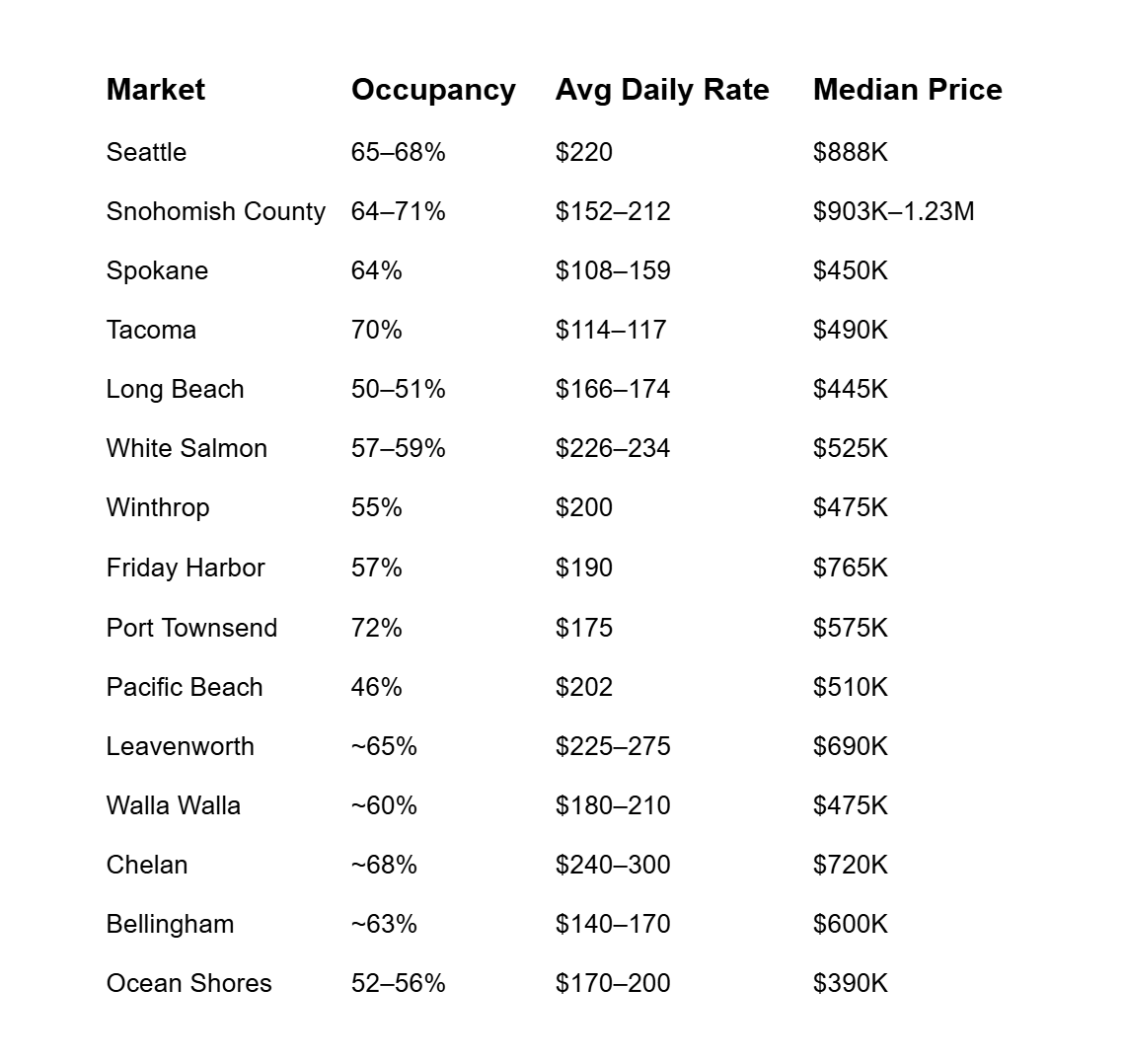
Understanding occupancy trends, nightly pricing, and housing costs is key to a successful Airbnb investment. This section outlines the most recent market data across 15 active rental hubs in Washington.


These short-term rental hotspots offer different strengths—from affordability in Spokane to premium pricing in Leavenworth.


1. Seattle – The Urban STR Powerhouse


Occupancy Rate: 65–68%
Avg Daily Rate:
$220
Median Price:
$888K


Tourism & Business in Seattle, Washington


Seattle’s short‑term rental sector thrives amid tech‑driven demand, sightseeing, and business travel. Active rentals near Pike Place Market and the Space Needle dominate year‑round booking. Strong demand supports above‑average pricing and consistent rental revenue.


Summary


As the top Airbnb market in Washington state, Seattle offers premium vacation rental opportunities—albeit with competitive entry and regulatory challenges.


2. Snohomish County – Suburban Gateway


Occupancy Rate: 64–71%
Avg Daily Rate:
$152–212
Median Price:
$903K–1.23M


Tourism & Business in Snohomish County


Just outside Seattle, this rental market appeals to vacationers and business travelers seeking affordability. Proximity to outdoor recreation boosts demand and active rentals. It’s a strong Airbnb investment alternative when Seattle’s market tightens.


Summary


High‑demand, short‑stay properties offer strong returns with a lower barrier to entry than the Seattle Airbnb market.


3. Spokane – Affordable Inland Market


Occupancy Rate: 64%
Avg Daily Rate:
$108–159
Median Price:
$450K


Tourism & Business in Spokane


A growing short‑term rental destination, Spokane benefits from conventions, university events, and outdoor tourism. Moderate rental demand supports steady occupancy and pricing for vacation rental investors diving into STR in Eastern Washington.


Summary


Budget-friendly real estate and stable occupancy make this a leading Airbnb market in Washington for value investors.


4. Tacoma – Waterfront & Arts Destination


Occupancy Rate: 70%
Avg Daily Rate:
$114–117
Median Price:
$490K


Tourism & Business in Tacoma

Tacoma’s STR demand is fueled by arts venues, museums, and port-driven business rentals. Short‑term rentals are popular among weekend visitors from Seattle, strengthening local rental income opportunities.


Summary

Tacoma stands out as a fast‑growing market where active rentals deliver reliable returns at a moderate price point.


5. Long Beach – Seasonal Coastal Play


Occupancy Rate: 50–51%
Avg Daily Rate:
$166–174
Median Price:
$445K


Tourism & Business in Long Beach


This beach town is a top summer vacation rental spot. Hosts adjust pricing seasonally, with fewer active rentals in winter. High summer pricing makes this a profitable market for hands‑on STR owners.


Summary


A top seasonal market; vacation rental demand peaks in summer with strong revenue potential.


6. White Salmon – Adventure Capital


Occupancy Rate: 57–59%
Avg Daily Rate:
$226–234
Median Price:
$525K


Tourism & Business in White Salmon


Adventure tourism drives steady demand in this Columbia River Gorge market. Active Airbnb listings near trails and rivers capture eco‑travel and wedding booking opportunities.


Summary


STR investors benefit from premium ADR and healthy demand in this scenic Washington property hotspot.


7. Winthrop – Mountain Retreat


Occupancy Rate: 55%
Avg Daily Rate: $200
Median Price: $475K


Tourism & Business in Winthrop


Gateway to North Cascades, Winthrop’s market is built on hikers, skiers, and summer escapes. Vacation rental pricing stays strong all year, supporting small-scale Airbnb investing.


Summary


A niche STR market with consistent demand—ideal for boutique rental investors.


8. Friday Harbor – Island Escape


Occupancy Rate: 57%
Avg Daily Rate: $190
Median Price: $765K


Tourism & Business in Friday Harbor


As a top vacation rental destination in the San Juan Islands, Friday Harbor sees demand for whale‑watching and scenic escapes. Vacation rental pricing is strong year‑round thanks to island scarcity.


Summary


Premium Airbnb market with stable bookings, ideal for real estate investors targeting vacation stays.


9. Port Townsend – Historic Seaport


Occupancy Rate: 72%
Avg Daily Rate:
$175
Median Price:
$575K


Tourism & Business in Port Townsend


Victorian charm, festivals, and arts draw short‑term guests. Active rentals are in high demand thanks to events and weekenders from Seattle.


Summary


A top‑performing short‑stay market with exceptional occupancy and heritage appeal.


10. Pacific Beach – West Coast Weekend Spot


Occupancy Rate: 46%
Avg Daily Rate:
$202
Median Price:
$510K


Tourism & Business in Pacific Beach


Beachfront rentals see strong summer booking. Hosts rely on vacation rental platforms for seasonal pricing and demand spikes.


Summary


Great ADR during peak season—best suited for owners planning vacation rental calendars carefully.


11. Leavenworth – Alpine Vacation Hub


Occupancy Rate: ~65%
Avg Daily Rate: $225–275
edian Price: $690K


Tourism & Business in Leavenworth


Oktoberfest, Christmas lights, and alpine hikes fuel year‑round rental demand. Active Airbnb listings thrive in this scenic Washington state town.


Summary


One of the most lucrative short‑term rental markets thanks to premium pricing and consistent occupancy.


12. Walla Walla – Wine Country Retreat


Occupancy Rate: ~60%

Avg Daily Rate: $180–210

Median Price: $475K


Tourism & Business in Walla Walla


Wine tourism drives steady demand in this peaceful town. STR pricing peaks during festivals and harvest season, enabling strong rental revenue.


Summary


Great for investors seeking a quieter, stable Washington Airbnb market with room for growth.


13. Chelan – Lakefront Luxury


Occupancy Rate: ~68%
Avg Daily Rate:
$240–300
Median Price:
$720K


Tourism & Business in Chelan


Lakefront properties, water sports, and wine tasting make Chelan an STR standout. Short‑term rental investors enjoy high ADR and peak season demand.


Summary


Top‑tier market for vacation rental revenue with luxury pricing and strong occupancy.


14. Bellingham – University & Outdoor Access


Occupancy Rate: ~63%
Avg Daily Rate:
$140–170
Median Price:
$600K


Tourism & Business in Bellingham


Home to Western Washington University and Cascade trail access, Bellingham delivers consistent rental demand. Business and college travelers support active rentals year‑round.


Summary


A dependable Washington Airbnb market offering diverse demand and moderate housing costs.


15. Ocean Shores – Family Beach Escape


Occupancy Rate: 52–56%
Avg Daily Rate:
$170–200
Median Price:
$390K


Tourism & Business in Ocean Shores


Weekend families and beachgoers generate steady short‑stay bookings. Active rentals focus on summer weeks and long weekends.


Summary


An accessible entry point for STR investors targeting family vacation rental demand.


Final Comparison Table


Final Thoughts


Washington State offers a diverse range of profitable Airbnb markets, from bustling urban hubs like Seattle to scenic getaways in the San Juans and Cascade Mountains. With high occupancy rates, strong average daily earnings, and growing tourism demand, the state continues to attract short-term rental investors.


While entering top-tier markets like Seattle may require navigating regulations and higher property prices, the long-term revenue potential remains strong.


For those seeking to maximize returns with minimal hassle, partnering with experienced property management companies like Home Team Luxury Rentals can help unlock the full value of a vacation rental investment in Washington.

Share to social media

More posts

By Elliott Caldwell April 17, 2026
Airbnb Management vs Self-Managing: Which Is More Profitable? Airbnb management vs self-managing is ultimately a decision about performance, not just cost. Most comparisons focus on management fees, control, or convenience. But for property owners and investors, the real question is simpler: Which approach produces more revenue—and better long-term returns? Because in short-term rentals, profitability is not determined by who does the work. It’s determined by how well the work is executed across pricing, occupancy, and guest experience. Why This Comparison Matters More Than Most Owners Realize At a glance, self-managing appears more profitable because it avoids management fees. But this assumption ignores how revenue is actually generated in the short-term rental market. Performance is driven by a small set of variables that compound over time: Nightly pricing strategy (ADR) Occupancy rate across seasons Listing conversion rate Guest experience and reviews Market positioning against competing listings What’s often overlooked is how sensitive these variables are to execution. According to the academic study Research on the Impact of Dynamic Pricing on Revenue Based on Airbnb Data , dynamic pricing strategies can increase annual income by approximately 30% compared to static pricing models . This reinforces a core principle: execution—especially pricing—directly impacts revenue outcomes . Real-world operator data shows that dynamic pricing systems typically increase revenue by 10% to 40% annually , along with measurable improvements in RevPAR and booking performance. At the individual booking level, pricing strategy becomes even more impactful. Data from PriceLabs shows that peak demand pricing adjustments can increase nightly rates by 50% to 200% , capturing value that static pricing models miss entirely. In other words, two nearly identical properties can produce very different results depending on how they are managed. What Is Self-Managing an Airbnb? Self-managing an Airbnb means the property owner is responsible for every aspect of the operation—from pricing to guest communication to maintenance. This is not just hosting. It is running a full hospitality business. Core responsibilities of self-managing include: Setting and adjusting nightly pricing Managing calendars and booking settings Communicating with guests before, during, and after stays Coordinating cleaning and maintenance Optimizing the listing (photos, amenities, descriptions) Monitoring reviews and responding to feedback Self-managing gives full control over decisions and operations. However, it also requires consistent time, attention, and market awareness. What matters most is not whether these tasks are completed, but how consistently and effectively they are executed over time. In practice, many self-managed properties rely on static or infrequently updated pricing. Pricing strategies that actively adjust based on demand, booking pace, and occupancy trends can significantly improve both nightly rates and booking volume, but require consistent monitoring and adjustment. What Is Airbnb Property Management? Airbnb property management involves hiring a professional company to handle the day-to-day operation and optimization of a short-term rental. This typically includes both operational execution and revenue strategy. Core responsibilities of Airbnb management include: Dynamic pricing based on demand, seasonality, and booking pace Listing optimization across platforms (Airbnb, Vrbo, Booking.com) Guest communication and support Cleaning coordination and quality control Performance tracking and reporting Ongoing adjustments based on market data Professional managers operate within a fundamentally different framework. Dynamic pricing systems continuously adjust rates based on supply and demand conditions , allowing operators to increase prices when demand is high and lower them strategically when demand softens. This allows operators to increase prices when demand is high and lower them strategically when demand softens—maximizing both occupancy and revenue. More advanced systems go even further. Operators like AvantStay identify dozens of micro-season demand windows throughout the year—short periods where pricing can be adjusted to capture incremental revenue that traditional seasonal pricing models overlook. The goal is not just to maintain the property, but to continuously optimize performance. Airbnb Management vs Self-Managing: The Real Difference At a surface level, both approaches involve the same core activities: Pricing the property Managing bookings Maintaining the guest experience Optimizing the listing But the real difference is not the tasks—it is the consistency, speed, and quality of execution. Self-managing relies on the owner’s time, experience, and ability to adapt Airbnb management relies on systems, automation, and continuous optimization This distinction matters because short-term rental performance is highly sensitive to small changes. For example, pricing strategies that actively balance demand have been shown to increase occupancy while also increasing revenue. Data from PriceLabs indicates that optimized pricing can produce ~11% higher occupancy alongside revenue gains , highlighting how these variables work together—not independently. Over time, these incremental improvements compound into significantly higher annual returns. Why Most Comparisons Get This Wrong Airbnb management vs self-managing is often framed as a simple cost decision: Self-managing = no management fees Management = 10–30% of revenue But this overlooks the most important factor: Revenue is not fixed—it is variable based on performance. What many owners fail to consider: How pricing strategy affects nightly rates How listing optimization impacts conversion How demand timing influences occupancy How their property compares to top-performing listings nearby From a foundational standpoint, dynamic pricing exists to align supply and demand in real time. As outlined by Harvard Business School, businesses that adjust pricing dynamically can optimize both utilization and profitability simultaneously. In short-term rentals, this means: Lower prices strategically to maintain occupancy during slow periods Increase prices aggressively when demand spikes Capture revenue across dozens of micro-demand windows throughout the year A property that executes this well can generate significantly more revenue—even after accounting for management fees. What This Article Will Help You Understand This guide breaks down Airbnb management vs self-managing from a performance perspective—not just a cost comparison. In the sections that follow, we’ll cover: The pros and cons of each approach How Airbnb revenue is actually generated Real-world revenue scenarios and comparisons Where self-managing tends to fall short When professional management becomes more profitable The goal is to give you a clear framework for making a decision based on outcomes—not assumptions. Bottom Line Airbnb management vs self-managing is not simply about who does the work—it is about how effectively the work is done. The same property, in the same market, can produce very different results depending on how it is managed. The difference is not the model—it is the execution behind it. Frequently Asked Questions
By Elliott Caldwell April 14, 2026
Airbnb management costs vary based on location, property type, amenities, and service level. Learn what drives pricing and how to evaluate fees based on performance.
A dinner table with seafood dishes and wine overlooking a sunset beach in Belleair Beach, Florida.
By John Ishmael Acuyado April 14, 2026
Discover where to dine in Belleair Beach FL with top nearby restaurants, beach dining spots, seafood grills, and local cafés just minutes from the shore.
Airbnb management typically costs 15%–35% of revenue. Learn what affects fees, what services are inc
By Elliott Caldwell April 13, 2026
Airbnb management typically costs 15%–35% of revenue. Learn what affects fees, what services are included, and whether Airbnb management is worth it for your property.
A sunset view over a beach with restaurant tables, shrimp, and a burger in the foreground, titled
By John Ishmael Acuyado April 10, 2026
Discover where to dine in Belleair Beach Florida with our guide to top restaurants, beach dining, seafood, steakhouses, and nearby local favorites in Clearwater and Belleair Bluffs.
Kayakers on a lake before snow-capped mountains, with text overlaying the scene:
By Menandro Bacalangco Jr. April 9, 2026
Discover the best kayaking spots near Palm Springs, CA! Enjoy lakes, rivers, and scenic waterways like Big Bear Lake, Lake Havasu, Lake Cuyamaca, and more.