
Do Tennis Courts Increase Vacation Rental Revenue?

Yes, tennis courts can increase vacation rental revenue, especially for luxury and resort-style properties targeting high-value travelers. A private tennis court can make a listing more attractive and help it stand out in competitive short-term rental markets.
In many cases, tennis courts perform best when combined with other premium amenities such as pools, outdoor lounges, or luxury outdoor spaces. This creates a more complete resort-style experience that supports stronger demand and occupancy.
Key Takeaways
- Tennis courts can make your rental stand out, attracting guests who value active recreation.
- Properties with tennis courts often see higher booking rates and can charge more per night.
- Careful planning of court placement and marketing is vital for maximizing its appeal.
- The initial cost of building a court needs to be weighed against potential revenue gains and ongoing maintenance.
- Tennis courts, when combined with other attractive amenities, can significantly boost overall property value and profitability.
The Impact Of Tennis Courts Increase Vacation Rental Revenue
Understanding The Appeal Of Tennis Courts For Guests
A private tennis court can turn a regular vacation rental into something people talk about for months. Vacationers aren’t just looking for a place to sleep—they want recreation, something to do in the morning or after dinner without leaving the rental. Tennis courts give guests a reason to stay longer, book with confidence, and bring more people. Kids get to run around, teens can be active, and adults might unwind competitively or teach the little ones.
- Instant activity: No planning or driving—just pick up a racket and play.
- Social fun: Families, friends, and big groups can play together.
- Status symbol: For some guests, a private court is just plain brag-worthy.
In many rental markets, the chance to play tennis without crowds or fees goes a long way in making a property stand out, especially for groups who value convenience and group activities.
How Tennis Courts Differentiate Your Property
Listing sites are swamped with homes featuring pools and fire pits, but tennis courts? Way less common. This makes your place pop in search results and gives you an edge when potential guests tap the “activities” or “tennis” filter (where available) or search for family/group-friendly features.
Ways a tennis court sets your property apart:
- Unique amenity attracts larger bookings (think sports tournaments, reunions, or corporate retreats).
- Your listing becomes more memorable, leading guests to share and recommend.
- Opportunity to market the court for events, lessons, or local round-robins.
| Feature | Commonly Listed | Stands Out in Search? |
|---|---|---|
| Pool | Yes | Rarely |
| Hot Tub | Yes | Not Always |
| Game Room | Occasionally | Sometimes |
| Tennis Court | Rarely | Yes |
Analyzing Guest Demographics Drawn To Tennis Courts
Properties with tennis courts tend to attract:
- Multi-generational families—grandparents, parents, kids, cousins (everyone can play)
- Sports enthusiasts and tennis-loving friend groups
- Corporate groups seeking on-site team-building or recreational options
- Vacationers who want to stay active without leaving the property
Younger guests (18–44) and groups are the fastest-growing demographic seeking on-site activities, sidestepping the old stereotype that tennis is just for older adults. Many high-value bookings—think bachelor/bachelorette parties or company off-sites—actively filter for places with luxury amenities like courts.
Larger groups want activities that fill downtime and keep everyone entertained under one roof. The more versatile your property, the broader your guest pool and the higher your potential revenue.
Quantifying Revenue Increases With Tennis Courts
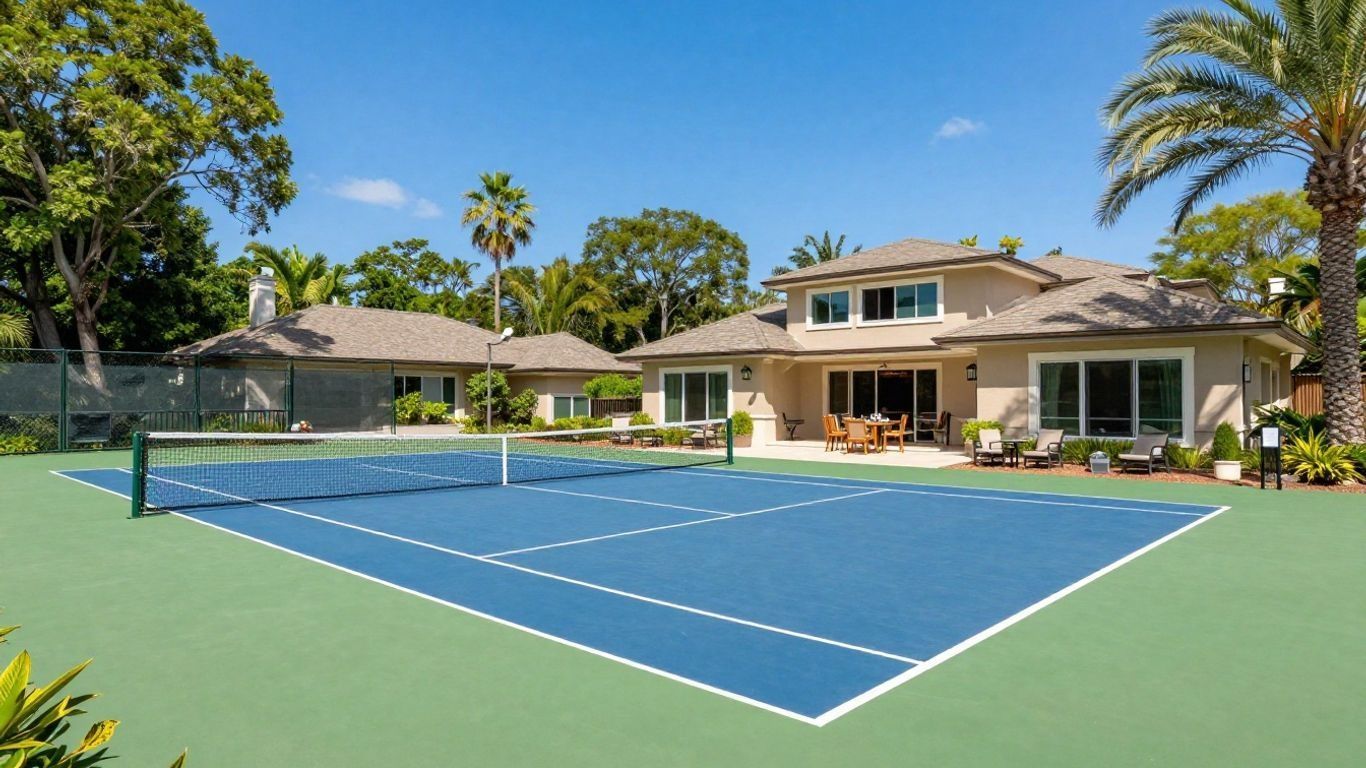
So, you're thinking about adding a tennis court to your vacation rental. It sounds fancy, right? But does it actually translate into more money in your pocket? The short answer is yes, but let's dig into how that happens.
Boosting Occupancy Rates Through Court Availability
Having a tennis court can really make your property stand out. Think about it: when people search for rentals, they often use filters for specific amenities. A tennis court can be that deciding factor for a group looking for a place with built-in entertainment. This means your property gets seen by more people who are specifically looking for what you offer, leading to more bookings. It's not just about filling random nights; it's about attracting guests who are already looking for an active vacation.
- Attracts specific guest segments: Families, groups of friends, and even corporate retreats often look for properties with activities.
- Acts as a powerful search filter: Guests searching for 'tennis' or 'sports' will find your listing.
- Reduces vacancy periods: The court provides a reason to book, especially during shoulder seasons when the weather might not be perfect for other outdoor activities.
Achieving Higher Average Daily Rates
Because a tennis court is a premium amenity, you can generally charge more per night. It positions your property as a more desirable, activity-rich destination. Guests are often willing to pay a bit extra for the convenience and fun of having a private court right there. This isn't just a small bump; in the right market, it can significantly increase your average daily rate (ADR).
Analyzing Revenue Per Available Rental (RevPAR) Gains
When you combine higher occupancy with higher nightly rates, your RevPAR naturally goes up. RevPAR is a key metric because it shows how well you're filling your rooms and how much you're earning from them.
Properties with courts often see a noticeable jump in this number. For example, properties with pickleball courts (a similar court sport) have been seen to earn an average of nearly $59,000 more annually than comparable properties without one. While tennis courts might have slightly different numbers, the principle is the same: a desirable amenity drives better financial performance across the board.
The real financial benefit comes from how the court changes guest behavior. Instead of guests leaving the property for entertainment, they stay put, book longer, and are willing to pay more for the convenience and fun right outside their door. This creates a positive cycle of increased bookings and higher earnings.
Here's a general idea of how it might break down:
| Metric | Property Without Court | Property With Tennis Court |
|---|---|---|
| Average Daily Rate (ADR) | $250 | $300+ |
| Occupancy Rate | 70% | 80%+ |
| Annual Revenue | $63,875 | $87,600+ |
(Note: These are illustrative figures and actual results will vary based on location, market demand, and property specifics.)
Strategic Implementation Of Tennis Courts
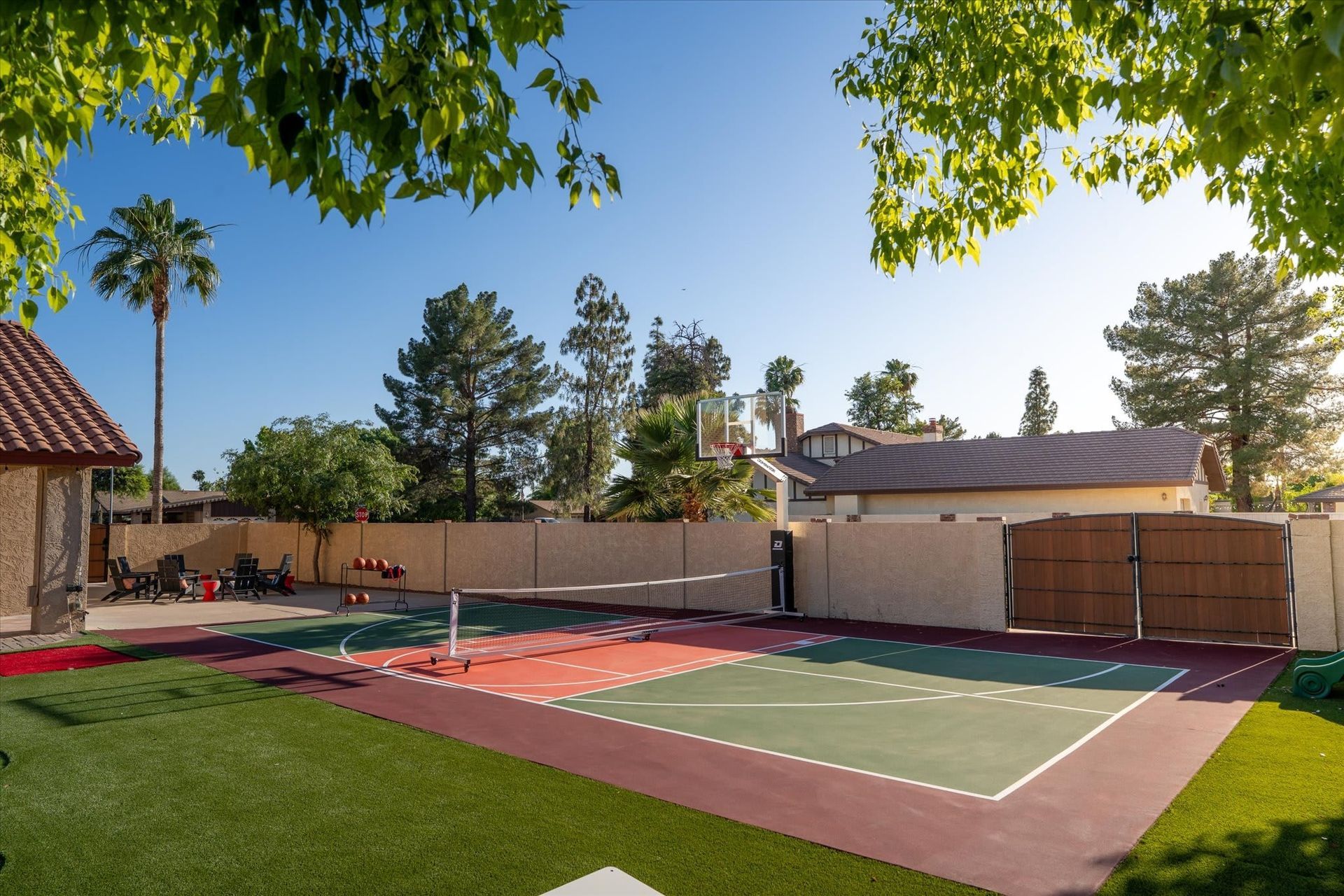
So, you've decided a tennis court is the way to go for your vacation rental. That's awesome! But just slapping one down isn't the whole story. You've got to think about where it goes, how it looks, and how you're going to tell people about it. It’s all about making it a real draw, not just another thing on the property.
Optimal Placement And Design For Rental Properties
Where you place a recreational court has a major impact on how guests actually use and experience it during their stay.
- Position the court where it is visible from main living areas or outdoor patios to encourage spontaneous use
- Integrate it into a broader outdoor “activity zone” alongside features like pools or barbecue areas
- Ensure the layout allows multiple groups to use different spaces comfortably without crowding
- Prioritize proper drainage and surface grading so the court remains usable after rain
- Design the court to feel intentional and integrated rather than added as an afterthought
Taken together, these considerations help ensure a court becomes a natural extension of the property rather than a standalone feature. When thoughtfully placed and properly designed, it enhances the overall flow of outdoor living space, improves usability in different conditions, and strengthens the property’s appeal as a well-planned, experience-driven vacation rental.
Marketing Your Tennis Court To Attract Bookings
Marketing a recreational court effectively is about making the amenity instantly visible, both in search results and in listing visuals, even when platforms don’t have dedicated filters.
- Include “tennis court” or similar keywords in the property title and early in the description for search visibility
- Use broader lifestyle terms like “outdoor games” and “family fun” to capture wider booking intent
- Invest in professional photography that highlights the court during optimal lighting conditions, such as golden hour
- Stage photos with equipment or guests actively using the space to help buyers visualize the experience
- Showcase how the court integrates with other amenities like pools, views, or outdoor entertainment areas
Taken together, these strategies position the property as a complete recreational experience rather than just an accommodation. When the court is clearly communicated, visually appealing, and framed within a broader lifestyle offering, it becomes a stronger booking driver and helps differentiate the listing in a competitive short-term rental market.
Integrating Courts With Other Property Amenities
A tennis court becomes significantly more valuable when it is designed and positioned as part of a broader recreational ecosystem rather than a standalone feature.
- Integrate the court with nearby amenities such as pools, hot tubs, or game rooms to create a unified activity zone
- Allow groups to split activities while staying close together, improving social flow for families and large parties
- Offer multiple recreational options on-site to increase perceived value and extend guest engagement time
- Package experiences such as court access, equipment rentals, and picnic setups to elevate the amenity into a curated activity
- Position the court as part of a larger lifestyle offering rather than a single-use feature
Taken together, these strategies shift the tennis court from a simple physical asset into an experience-driven amenity. When it is intentionally connected to other recreational spaces and supported by optional bundled experiences, it strengthens the overall vacation narrative of the property and increases its appeal as a destination built around activity, convenience, and shared experiences.
Financial Considerations For Tennis Court Investments
So, you're thinking about adding a tennis court to your vacation rental. That's a pretty big step, and it's smart to look at the money side of things before you start digging. It's not just about the initial cost, but also what you'll need to keep it up and how long it'll take to actually make your money back.
Estimating Construction And Installation Costs
Building a tennis court isn't exactly cheap. You're looking at a pretty wide range, depending on what you want and what your property needs. A basic setup, including site prep, a solid foundation (like concrete or asphalt), the actual playing surface with lines, some fencing around the edges, and a net system, can run anywhere from $25,000 to $50,000. If you want to add lighting for evening play, that's another $5,000 to $10,000 on top of that. If your land isn't already flat or needs drainage work, expect those costs to climb even higher.
Here's a rough idea of what goes into the price:
- Site Preparation: Clearing land, grading, and ensuring proper drainage.
- Foundation: Concrete or asphalt base for stability.
- Surface & Lines: Acrylic surfacing with painted court lines.
- Fencing: Perimeter fencing for safety and ball containment.
- Net System: Regulation net, posts, and hardware.
- Lighting (Optional): LED fixtures for nighttime use.
Calculating Break-Even Timelines And ROI
This is where you figure out when the court starts paying for itself. The general idea is to divide the total cost of building the court by how much extra money you expect it to bring in each year. For example, if you spend $35,000 on a court and it helps you make an extra $58,970 annually (which is what some studies show), you could potentially break even in about seven months. But, and this is a big 'but', this timeline really depends on a few things specific to your property.
- Your Current Occupancy: If your rental is already booked solid most of the year, the extra bookings from a court won't add up as much as they would for a property that's often empty.
- Market Saturation: If you're the only place around with a tennis court, you'll likely see faster returns because you're a unique draw. If everyone else has one, it's harder to stand out.
- Guest Demographics: Properties that attract groups, like families on vacation or corporate retreats, tend to see more value from a court than places that mostly get couples.
The real return on investment isn't just about the initial cost versus the revenue bump. It's about how that amenity changes your property's appeal, allowing you to charge more per night and fill more nights throughout the year, especially when compared to properties that don't offer similar unique features.
Budgeting For Ongoing Maintenance And Upkeep
Ongoing costs are an important part of planning for a tennis or pickleball court, since maintenance needs continue well after construction is finished.
- Budget around $300 to $1,000 per year for routine upkeep, including cleaning and minor repairs
- Plan for resurfacing every 4 to 8 years, typically ranging from $1,500 to $3,500 depending on condition and materials
- Replace nets every 2 to 3 years, with costs generally between $300 and $1,500 based on quality
- Maintain basic equipment such as paddles and balls, adding roughly $300 to $500 annually
- Account for long-term maintenance as part of the total cost of ownership, not just the initial build
Taken together, these expenses highlight the importance of viewing a court as an ongoing investment rather than a one-time purchase. While the upfront build is the most visible cost, consistent upkeep ensures the playing surface remains safe, attractive, and enjoyable for guests, which in turn protects the property’s appeal and supports continued use as a premium recreational amenity.
Tennis Courts Versus Other Premium Amenities
So, you're thinking about adding a tennis court to your vacation rental. That's cool, but how does it stack up against, say, a pool or a hot tub? It's a big question, and the answer really depends on what you're going for and who you want to attract.
Comparing ROI With Pools and Hot Tubs
Pools are pretty much the king of vacation rental amenities. They can seriously bump up your nightly rates, often by 15-20%. But, man, they cost a pretty penny to install, usually somewhere between $50,000 and $100,000, sometimes more. Hot tubs are a bit more budget-friendly, costing maybe $5,000 to $10,000, and they can add a good 20-25% to your nightly rate. They're especially popular in places with distinct seasons.
Tennis courts, or more commonly now, pickleball courts, fall somewhere in the middle cost-wise, typically $25,000 to $50,000. Their revenue boost can vary a lot depending on how many other places have them. If you're the only one with a court, you'll likely see a bigger jump in rates than if courts are already a common feature.
| Amenity | Installation Cost | Nightly Rate Premium | Break-Even Timeline |
|---|---|---|---|
| Pickleball Court | $25k - $50k | Varies | 7-18 months |
| Swimming Pool | $50k - $100k+ | 15-20% | 24-36 months |
| Hot Tub | $5k - $10k | 20-25% | 6-12 months |
Evaluating Tennis Courts Against Game Rooms
Game rooms and tennis courts both function as high-impact vacation rental amenities, but they serve different guest motivations and market segments.
- Game rooms typically require a setup cost of around $10,000 to $15,000, depending on equipment and design
- They can support an estimated 10–15% increase in nightly rates by adding indoor entertainment value
- Game rooms tend to appeal to more specific groups such as families with older children or social groups seeking indoor leisure
- Tennis courts generally attract a broader, more active audience focused on outdoor recreation and wellness-oriented experiences
- Game rooms emphasize passive or casual entertainment, while tennis courts center on physical activity and engagement
Taken together, these differences highlight how amenity selection shapes guest targeting and booking behavior. While a game room creates value through indoor social entertainment, a tennis court positions the property as a more active, outdoor-focused destination. Choosing between them—or combining both—depends on whether the goal is to appeal to niche indoor leisure travelers or a wider range of guests seeking experiential, activity-driven stays.
Strategic Amenity Investment For Maximum Returns
Choosing the right amenity comes down to aligning guest demand, market saturation, and your property’s positioning within the local STR landscape.
- Evaluate your target guest segments (families, groups, corporate retreats, active travelers) before investing
- Analyze local competition to identify which amenities are already overrepresented (such as pools or hot tubs)
- Use a tennis court as a potential differentiator in markets where similar listings lack active outdoor recreation options
- Prioritize amenities that directly match how your ideal guests spend their time during a stay
- Balance upfront investment against expected impact on occupancy, nightly rates, and booking conversion
Taken together, these considerations show that amenity strategy is not just about adding features, but about selecting the ones that create the strongest competitive advantage. A tennis court can be a powerful differentiator in the right market, particularly for properties targeting active groups or experience-driven travelers. However, the strongest returns typically come from matching the amenity mix to both local supply conditions and clear guest demand, ensuring each addition meaningfully enhances the property’s appeal and booking performance.
Leveraging Tennis Courts For Long-Term Profitability
Enhancing Property Value Through Desirable Amenities
A tennis court can function as a long-term capital improvement that enhances both short-term rental performance and overall property value.
- Increase long-term property appeal by adding a durable, high-demand recreational amenity
- Strengthen competitive positioning in the vacation rental market over multiple seasons
- Support higher perceived value, which can influence resale and refinancing potential
- Contribute to stronger differentiation compared to similar properties without premium amenities
- Build equity not just through structure, but through enhanced lifestyle and experience offerings
Taken together, these factors position a tennis court as more than just a booking driver—it becomes a strategic asset. When properly maintained and aligned with guest demand, it can enhance both revenue potential and long-term valuation, reinforcing the property’s desirability in both the short-term rental market and broader real estate investment context.
Utilizing Data To Optimize Tennis Court Performance
So, you've got the court. Now what? To really make it pay off long-term, you need to pay attention to the numbers. It’s not enough to just have the amenity; you need to know how guests are using it and how it’s affecting your bookings and rates.
Tools that track occupancy, average daily rates (ADR), and booking patterns before and after the court was installed can show you exactly what’s working. Are guests booking longer stays because of the court?
Are you able to charge more per night? Analyzing this data helps you fine-tune your pricing strategy and marketing efforts. For example, if you see a spike in bookings during certain local tournaments, you can adjust your rates accordingly for those periods.
Here’s a look at how a tennis court might impact key metrics:
| Metric | Pre-Court Average | Post-Court Average | Potential Increase |
|---|---|---|---|
| Occupancy Rate | 65% | 75% | ~15% |
| Average Daily Rate | $300 | $350 | ~17% |
| Annual Revenue | $70,080 | $91,980 | ~$22,000+ |
Note: These figures are illustrative and will vary based on location, market demand, and property specifics.
The Role Of Property Management In Maximizing Court Revenue
A tennis court delivers the strongest return when it’s paired with structured management and intentional marketing, rather than treated as a passive feature.
- Use property management to coordinate court scheduling and avoid guest conflicts
- Maintain consistent upkeep so the court remains visually appealing and safe to use
- Create guest-facing experiences such as casual tournaments, lessons, or scheduled play sessions
- Integrate the court into pricing strategy to support premium nightly rates
- Actively position the court in listings and marketing materials as a core selling feature
Taken together, these strategies ensure the court contributes to both guest satisfaction and revenue performance. With proper management, a tennis court becomes more than just an amenity—it functions as an organized recreational offering that enhances the overall stay experience, strengthens booking appeal, and supports higher long-term returns for the property.
Conclusion
Adding a tennis court to your vacation rental property can be a smart move. It's not just about having a place to play; it's about attracting more guests, charging more per night, and ultimately making more money. While there's an upfront cost and ongoing upkeep, the data suggests that the return on investment can be significant, especially when you market it right and integrate it with other great features your property offers. Think of it as an investment in guest experience that pays off in higher occupancy and better reviews.
Frequently Asked Questions
Will adding a tennis court really make my rental more money?
Yes, it often does. Think of it like adding a cool feature that makes people want to book your place over others. Guests might pay more per night because of it, and more people might book your place overall, especially if they're looking for a place with fun things to do.
How much does it cost to put in a tennis court?
It can cost a good amount, usually tens of thousands of dollars. This includes getting the land ready, building the court itself, and putting up fences. The exact price depends on the size, materials, and where you are.
Is a tennis court better than a pool or hot tub for my rental?
It depends on who you want to attract. Pools and hot tubs are super popular, but tennis courts can be a big draw for people who love sports or want active fun. If your area already has lots of places with pools, a tennis court might make you more unique.
How do I get people to know my rental has a tennis court?
You need to show it off! Use great pictures of the court in your listing. Mention it right in the description and title. You can even suggest fun activities like 'family tennis matches' to get people excited.
What if I don't have a lot of space for a tennis court?
You might not need a full-sized court. Sometimes a smaller, modified court or even a dedicated pickleball court (which is smaller) can still be a big hit with guests looking for active amenities.
Do I need to worry about maintaining the tennis court?
Definitely. Courts need regular cleaning, net repairs, and sometimes resurfacing. You'll need to budget for this upkeep to keep it looking good and safe for guests. It's part of making sure your investment keeps paying off.
Can a tennis court help increase revenue for a short-term rental?
Yes. A tennis court can help increase revenue by making a short-term rental more attractive to travelers seeking active amenities. Properties with unique recreational features often command higher nightly rates and experience stronger booking demand throughout the year.
How does a tennis court affect rental profit?
A tennis court can improve rental profit by supporting premium pricing and encouraging longer stays. While there are maintenance costs to consider, many owners find that the additional bookings and higher rates offset those expenses over time.
Share to social media
More posts