
Short-Term Rental Regulations in Fort Lauderdale, FL & License Guide for Vacation Rentals
By: Elliott Calwell |
Short-Term Rental Regulations in Fort Lauderdale, FL: Vacation Rental License Guide
Fort Lauderdale is one of Florida’s most popular vacation destinations, attracting tourists to its beaches, canals, and vibrant neighborhoods.
For property owners, short-term rentals (STRs) offer a lucrative opportunity, but operating an STR in Fort Lauderdale requires careful adherence to city, county, and state laws and regulations.
From licensing and safety inspections to zoning and taxes, understanding the rules is essential to avoid fines and ensure a smooth hosting experience.
What Is a Short-Term Rental in Fort Lauderdale?
A short-term rental is generally defined as a residential unit or condo rented more than three times per year for periods of less than 30 days (or one calendar month). Apply via the MyFloridaLicense website. This includes:
- Single-family homes
- Condos and townhomes
- Duplexes, triplexes, and four-plexes
Fort Lauderdale is considered one of the more flexible STR markets in Florida, but there are specific requirements that all hosts must follow.
License and Registration Requirements
Operating short-term rentals legally requires obtaining licenses at the state, county, and city levels.
1. State Level
- A Vacation Rental License from the Florida Department of Business and Professional Regulation (DBPR) is mandatory.
2. County Level
- Broward County Business Tax Receipt (BTR)
- Tourist Development Tax (TDT) account
3. City Level
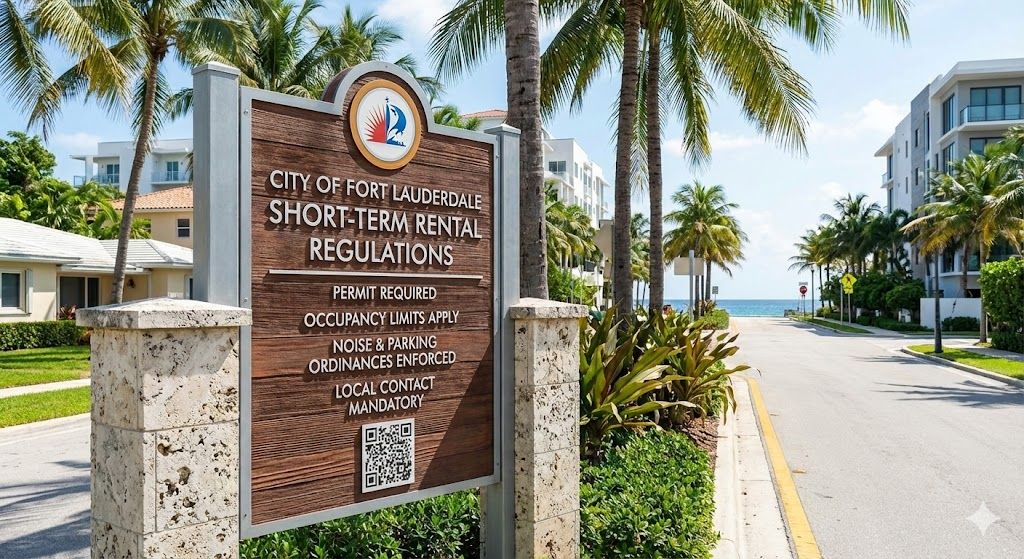
- Register your property with the City of Fort Lauderdale Vacation Rental Registration Program via the LauderBuild portal.
- Complete a safety inspection to obtain a Certificate of Compliance.
- Fees: Initial registration and inspection cost around $460 per dwelling, with annual renewal required.
Zoning and Occupancy Rules Under Rental Laws
- STRs are allowed in most zoning districts, but some restrictions apply, such as
prohibited use in accessory dwelling units in RS-8 and RS-15 districts.
- Occupancy limits: Maximum of two people per legal bedroom.
Operational and Safety Standards for Short-Term Rentals
Fort Lauderdale enforces strict operational standards to protect guests and neighborhoods staying in short-term rentals.
- Responsible Party: A local contact must be available 24/7 for emergencies or complaints (Sec. 15-275)
- Noise Monitoring: All STRs must have a noise detection device with data retention for 180 days (Sec. 15-276(f))
- Parking Rules: Vehicles must park off-street; a parking plan may be required (Sec. 15-276(e))
- On-Site Information: Emergency contacts, evacuation diagrams, and property rules must be clearly posted (Sec. 15-276(c))
- Annual Safety Inspections: Fire, building, and life safety inspections are required to maintain compliance (Sec. 15-278 and Sec. 15-276(b))
Tax Obligations in Broward County
As an STR host, you are responsible for collecting and remitting taxes. Register on the Florida DOR website.
- Florida State Sales Tax: 6%
- Florida Discretionary Sales Surtax: 0.5%–1.5%
- Broward County Tourist Development Tax (TDT): 6%
Platforms like Airbnb and Vrbo often collect and remit taxes on your behalf, but hosts remain ultimately responsible for ensuring all taxes are paid.
Penalties for Non-Compliance
Violating STR regulations can result in:
- Fines: Starting at $250 per violation and up to $15,000 per day for serious or repeated offenses.
- License Suspension or Revocation: Operating without a valid registration or failing inspections can lead to permanent removal of STR privileges.
By following these rules, short-term rentals can be both profitable and safe for owners and guests alike.
Final Thoughts
Fort Lauderdale’s STR market offers an exciting opportunity for property owners, but navigating licenses, inspections, zoning, and taxes is crucial. By following the regulations, you protect your investment, provide a safe experience for guests, and avoid hefty fines.
Whether you own a condo near Las Olas Boulevard or a beachfront home, proper registration, safety compliance, and tax collection are non-negotiable for short-term rentals in Fort Lauderdale.
For hosts looking to simplify operations, partnering with a professional Fort Lauderdale Airbnb & Vacation Rental Managementcompany can help streamline bookings, guest communication, and compliance with all STR laws.
FAQs
- Q1: What counts as a short-term rental in Fort Lauderdale?
A unit rented more than three times per year for less than 30 days. - Q2: Do I need a local contact for my rental?
Yes, a responsible party must be available 24/7 to handle emergencies. - Q3: Can I rent out a guest house in Fort Lauderdale?
Only if zoning permits. Check city zoning maps before listing. - Q4: Are there occupancy limits for short-term rentals?
Yes, typically two people per legal bedroom. - Q5: Who collects taxes for short-term rentals?
Hosts are responsible, though platforms like Airbnb may remit on your behalf. - Q6: Do I need a city, county, and state license to operate in Fort Lauderdale?
Yes, all three levels require proper registration and licensing. - Q7: Are there noise regulations for short-term rentals?
Yes, all rentals must have a noise detection device and comply with local laws. - Q8: How often are inspections required in Fort Lauderdale?
Annual safety inspections are mandatory for all STR properties. - Q9: What happens if I violate short-term rental laws?
Fines start at $250 and can go up to $15,000 per day. Your rental license may also be suspended. - Q10: Can I rent my property during peak tourist season in Fort Lauderdale?
Yes, as long as you comply with all STR laws, licensing, occupancy, and safety requirements.
Share to social media
More posts