

Casago Airbnb Management Review

Casago Property Management Review
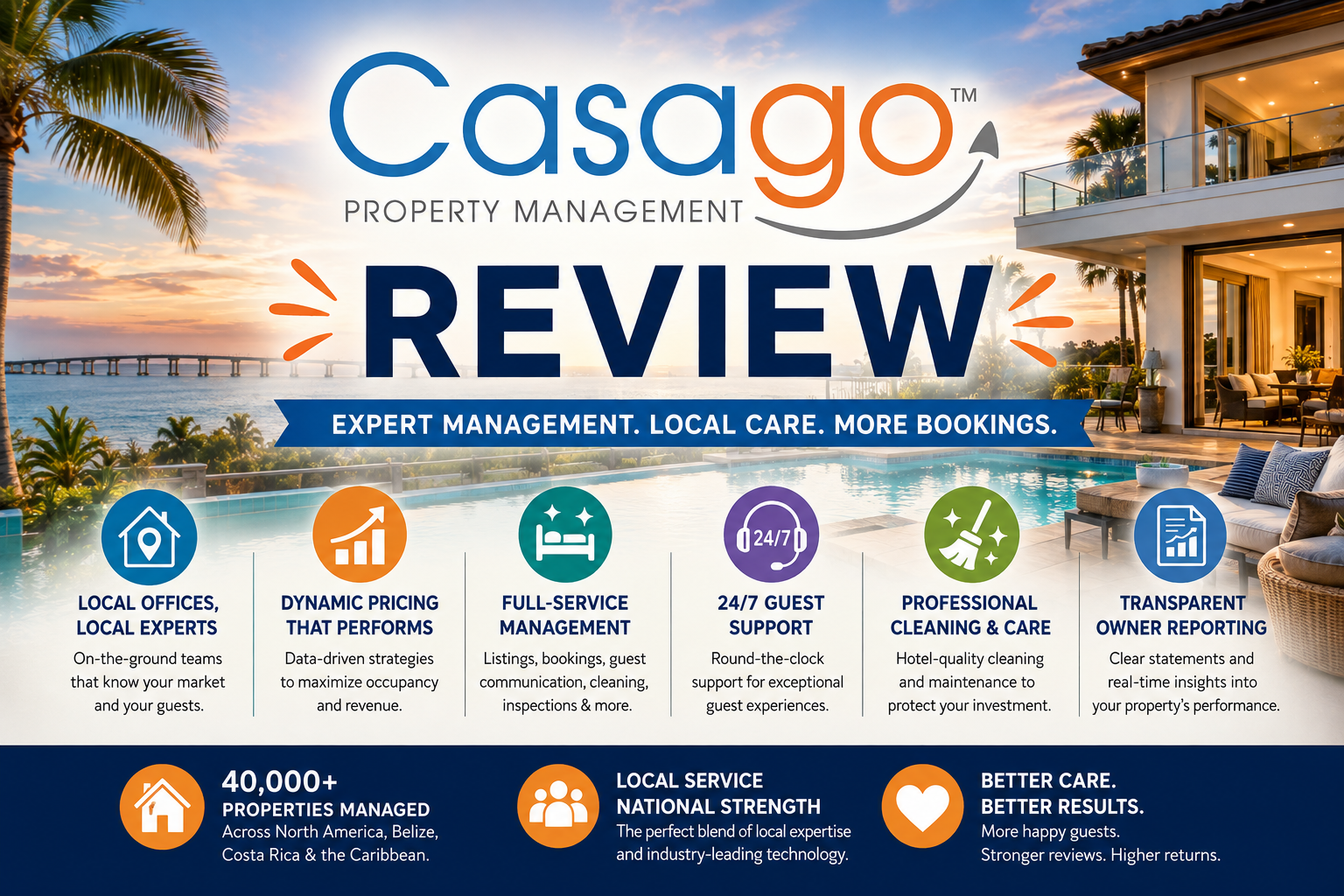
Vacation homeowners looking for hands-off support will find Casago positioned as a full-service operator with both local personnel and national-scale infrastructure. The company handles many of the responsibilities involved in running a short-term property, including professional listing setup, dynamic pricing, reservations, housekeeping, inspections, maintenance coordination, financial reporting, and round-the-clock guest support.
The scale of the organization changed substantially when it completed its acquisition of Vacasa in May 2025. At the time of the transaction, the combined organization reported managing more than 40,000 properties across North America, Belize, Costa Rica, and the Caribbean. The stated strategy behind the combination was to pair national infrastructure with locally rooted service rather than operate every home through a completely centralized system.
For homeowners, that local component is one of the most important parts of the offering. Individual offices can handle housekeeping, inspections, local service needs, and owner relationships, while broader systems support pricing, reservations, technology, and distribution.
The model has several notable strengths:
- Local people responsible for day-to-day execution
- Professional housekeeping and turnovers
- Dynamic rate optimization
- Broad listing exposure
- 24/7 traveler support
- Owner reporting and financial visibility
- Inspection and maintenance processes
- Technology supporting operations
- Flexible services in some markets
There is also an important tradeoff. Because individual offices are locally operated, the exact service package, pricing, reputation, and homeowner experience can differ from one market to another. Evaluating the specific office responsible for the home is therefore just as important as evaluating the national brand.
What Casago Is and How Its Local Model Works
Casago is a full-service vacation rental operator built around local execution supported by a larger network. Its Owner-Centric™ philosophy emphasizes homeowner advocacy, transparency, stewardship, communication, and revenue optimization, with local professionals responsible for much of the physical care of each home.
The operating structure typically brings together several functions:
- Homeowner relationship support
- Housekeeping personnel
- Property inspections
- Local hospitality staff
- Revenue specialists
- Reservation support
- Maintenance professionals
- Financial reporting tools
- After-hours assistance
The franchise model helps explain why local execution is so central. Franchisees gain access to technology, training, revenue resources, reservation support, purchasing power, and other shared systems while operating within defined markets. Casago's current privacy policy also confirms that franchised property management companies are independently owned and operated.
This structure attempts to combine two advantages that can sometimes be difficult to achieve simultaneously: the resources of a large organization and the responsiveness of people who understand the market in which the home actually operates.
That local knowledge can matter when managing issues that are difficult to resolve remotely, including:
- Cleaning quality
- Emergency repairs
- Seasonal property preparation
- Local vendor relationships
- Weather-related issues
- Community or HOA considerations
- Traveler questions requiring destination knowledge
The structure also means homeowners should not assume that every office offers exactly the same experience. The central FAQ specifically advises prospective clients to confirm the details of available services with their local operator, and customizable options such as design assistance are available only in certain markets.
Management Services and Property Care
The published management services cover most of the major responsibilities associated with operating a professionally managed short-term home. Casago describes its offering as end-to-end service spanning digital marketing and reservations through cleaning, local hospitality, and physical home care.
Core services may include:
- Professional photography
- Listing creation and optimization
- Dynamic pricing
- OTA distribution
- Reservation support
- Guest communication
- Housekeeping and laundry
- Full turnovers
- Quality inspections
- Maintenance coordination
- Local hospitality support
- Owner financial reporting
- Tax collection and remittance where applicable
Housekeeping is a meaningful part of the operating model rather than simply a referral service. The company's FAQ says trained housekeeping teams follow a multi-point checklist, that homes are inspected after cleaning, and that linens are commercially laundered.
Physical home care is also incorporated into the broader service. Routine work may be completed by in-house personnel or vetted third-party professionals depending on the task and market. Homeowners generally remain responsible for the cost of repairs, while the company says work is documented and communicated through its reporting systems.
That degree of local involvement can be particularly useful for an absentee homeowner. Instead of coordinating separate cleaners, inspectors, emergency contacts, and vendors from another state, the owner can place many of those responsibilities within one operating relationship.
There are still several questions worth asking before signing an agreement:
- Who personally inspects the home after each turnover?
- Which services are performed in-house?
- Which tasks are outsourced?
- How are repair approvals handled?
- What spending threshold requires owner approval?
- How quickly are emergency issues addressed?
- Are work orders documented with photographs?
- How are recurring problems tracked?
- What happens if a homeowner is dissatisfied with a completed service?
Answers may vary by office, making the local consultation particularly important.
Revenue Strategy, Marketing, and Distribution
Revenue optimization combines technology with local market input. According to the company's FAQ, nightly rates are adjusted using demand, seasonality, events, competing rates, and booking pace, with revenue specialists working alongside local teams and homeowners.
That combination can be helpful because short-term demand often responds to circumstances that do not fit neatly
into a static seasonal calendar. Relevant factors may include:
- Major local events
- Holidays
- School vacation periods
- Beach or ski seasons
- Weather conditions
- Day-of-week demand
- Booking lead times
- Last-minute inventory
- Competitor pricing
- Length-of-stay patterns
The company also provides marketing and professional listing support. Its central website says properties can be promoted across major booking platforms, including Airbnb, Vrbo, vacasa.com, and Casago.com, as well as relevant regional and niche channels.
Broad distribution is useful because it reduces dependence on a single source of demand. However, putting a home on more websites does not automatically make that home more competitive.
Travelers still compare factors such as:
- Photography
- Nightly rate
- Amenities
- Design
- Sleeping capacity
- Reviews
- Outdoor spaces
- Overall presentation
- Perceived value
That distinction is particularly important for luxury and large-group properties. A home with excellent fundamentals may primarily need broader exposure and better rate execution, while an underperforming home may need physical or strategic changes before additional traffic translates into more reservations.
Fees, Contracts, and Owner Economics
There is no single nationwide commission publicly stated for every office. The central FAQ says fees vary according to market and service level and should be clearly specified in the homeowner's agreement. It also states that charges not disclosed in advance should not appear later as hidden markups.
Current local pages illustrate how pricing can differ. In Sedona, for example, the operator publishes an all-inclusive full-service fee ranging from 20% to 30% depending on property size. A Park City page publishes the same 20% to 30% range. These are useful examples, but they should not be interpreted as universal pricing across the entire network.
A proposal should clearly identify costs associated with:
- Management commission
- Housekeeping
- Repairs
- Linen service
- Consumable supplies
- Photography
- Initial setup
- Credit-card processing
- Owner stays
- Taxes
- Traveler-facing charges
- Contract termination
The central property-management page currently promotes no hidden fees and no long-term contracts, although local contract terms can still differ. For example, the Sedona page specifies a 60-day cancellation notice while honoring existing reservations.
This variation is another reason homeowners should avoid comparing property managers only by headline commission. A 20% agreement that includes substantial local operating work is not necessarily more expensive in practice than a lower percentage that requires the homeowner to separately coordinate several additional vendors.
For a rental property, the more useful financial comparison should include:
- Gross booking revenue
- Management costs
- Cleaning expenses
- Repair and upkeep expenses
- Owner time commitment
- Net proceeds
- Expected property wear
- Revenue growth potential
A lower percentage is valuable when the service scope still addresses the home's most important needs. A higher percentage may also be justified when the added work improves revenue, protects the asset, or materially reduces owner involvement.
Reviews, Reputation, and Local Service Variability
Online reviews should be interpreted carefully because the local-office structure can produce significantly different results from one operation to another. There is no single review profile that perfectly represents every home or market operating under the brand.
The Better Business Bureau illustrates this variation particularly clearly. As of August 2026, the BBB profile associated with the Scottsdale headquarters shows an F rating and identifies 12 complaints in the previous three years, including seven that the BBB says were not answered. Its customer-review page currently reports an average of 1.45 out of 5 from 20 reviews.
Some complaints and guest reviews associated with that profile mention communication problems, reservation issues, cleaning concerns, or poor maintenance at individual properties. These reports are important for due diligence, but they should not automatically be generalized to every independently operated office.
For comparison, the BBB profile for the Santa Barbara operation currently carries an A+ rating. That contrast reinforces why the most useful Casago rating may be the reputation of the particular office serving the homeowner's market rather than a national average.
Prospective clients can investigate local performance by reviewing:
- Recent homeowner feedback
- Recent traveler feedback
- Complaints involving comparable homes
- Responsiveness to negative feedback
- Cleaning consistency
- Repair response times
- Local leadership
- Length of operating history
- Reviews of actual listings managed by the office
When the local operation is strong, the structure has the ingredients of a solid full-service manager: nearby staff, housekeeping systems, inspections, pricing expertise, traveler support, and national booking infrastructure. The risk is that execution can be more dependent on local leadership than it would be under a completely standardized centralized system.
Major Strengths and Potential Tradeoffs
The strongest case for the model is its combination of local care and broader infrastructure. A homeowner can receive hands-on service without giving up the revenue technology, booking reach, and systems available through a large organization.
Key strengths
Notable advantages include:
- Local personnel close to the home
- Full turnover and housekeeping capabilities
- Post-clean inspections
- Dynamic rate strategy
- Major OTA exposure
- 24/7 support
- Owner portal access
- Traveler screening
- Financial reporting
- Flexible local expertise
- National-scale infrastructure
The acquisition of Vacasa significantly expanded that infrastructure. When the transaction closed in May 2025, the combined organization reported more than 40,000 homes and explicitly described its strategy as combining national advantages with personalized local care.
Potential tradeoffs
Homeowners should also consider several limitations:
- Pricing can differ across markets.
- The exact service package may vary by office.
- Local leadership can have a major effect on execution.
- Design assistance is not equally available everywhere.
- Repair expenses remain an owner responsibility.
- A national brand does not eliminate the need to research the local branch.
Interior design is a good example of this variability. Casago says design or staging assistance exists in some markets, but it is not presented as a standardized service available everywhere.
That does not mean the organization ignores the physical quality of the home. Inspections, upkeep, owner recommendations, and local stewardship are clearly part of its offering. The more relevant question for a homeowner with significant improvement opportunities is how deeply the specific office participates in design strategy, renovations, amenity planning, and repositioning.
Which Owners and Properties Are the Best Fit?
The company itself identifies absentee homeowners, second-home owners, real estate investors, and first-time short-term hosts as groups that can benefit from its approach. The common thread is a desire for professional operating support combined with nearby personnel who can look after the physical home.
The model may be particularly appropriate for:
- Owners who live far from the property
- Second homes used personally part of the year
- Established vacation homes needing full operations
- Investors who value professional rate management
- Homeowners who do not want to coordinate housekeeping themselves
- Homes where rapid local response is important
- Properties already positioned effectively for their target traveler
A homeowner seeking a largely hands-off experience may especially value having housekeeping, inspections, traveler communication, reservations, and physical home care coordinated through the same operating structure.
The decision becomes more nuanced for luxury properties with significant untapped potential. High-end homes often compete on more than cleanliness, availability, and price. Design, private amenities, gathering spaces, entertainment, outdoor living, privacy, and experiential features may influence both conversion and the nightly rate travelers are willing to pay.
For these homes, useful questions include:
- Is the current design appropriate for the target traveler?
- Is bedroom capacity being used effectively?
- Could outdoor areas generate more value?
- Are competing homes more heavily amenitized?
- Does the listing clearly communicate a premium experience?
- Could physical improvements support a higher rate?
- Is the home targeting the most profitable traveler segment?
- Does the local office provide the strategic support required to make those changes?
The answers help determine whether the primary need is operational excellence or deeper asset optimization.
Casago vs. Home Team Luxury Rentals
Casago and Home Team Luxury Rentals overlap in several important areas. Both provide full-service support, dynamic pricing, listing optimization, traveler communication, cleaning coordination, physical upkeep, and multi-platform booking exposure.
The differences are more apparent in scale, operating structure, target property profile, and the emphasis each business places on improving the underlying hospitality asset.
| Category | Casago | Home Team Luxury Rentals |
|---|---|---|
| Primary operating model | Full-service network combining locally operated offices with national infrastructure | Full-service premium and luxury vacation-home management |
| Primary emphasis | Local stewardship, day-to-day operations, owner transparency, revenue optimization | Hospitality operations, revenue optimization, property competitiveness, long-term asset performance |
| Local operations | Major component of the model through locally operated offices | Local cleaning and service partners supported by centralized strategy and accountability |
| Scale | More than 40,000 properties reported after the 2025 Vacasa acquisition | More specialized focus on premium and luxury short-term properties |
| Revenue strategy | Dynamic pricing informed by data and local market knowledge | Dynamic pricing combined with ongoing performance and positioning strategy |
| Housekeeping | Professional local housekeeping, commercial laundry, and inspections | Cleaning coordination and quality-control processes within full-service operations |
| Maintenance | Local in-house personnel and vetted specialists depending on the task | Vendor coordination and oversight tied to broader property-performance goals |
| Owner reporting | Owner portal with booking, financial, and property information | Financial reporting and performance tracking |
| Booking channels | Major OTAs plus Casago and Vacasa channels | Multi-platform listing and booking strategy |
| Interior design | Available in some markets | Design, furnishing, and improvement support available within the broader investment ecosystem |
| Amenity strategy | Property recommendations may depend on the local office | Amenity and physical improvement opportunities explicitly tied to asset performance |
| Published pricing | Varies by office; some markets publish 20%–30% | Generally 15%–22% depending on property, market, and service requirements |
| Best fit | Owners prioritizing comprehensive local care backed by a large network | Owners prioritizing premium-property performance and deeper asset optimization |
Home Team Luxury Rentals describes its approach as operating at the intersection of hospitality and real estate investment. Its full-service program includes dynamic pricing, listing optimization, traveler support, cleaning coordination, maintenance oversight, reporting, and multi-platform exposure, while its broader strategy also considers property improvements and amenity investments.
Home Team currently publishes performance-based rates generally ranging from 15% to 22% of gross revenue, depending on the home, market, expected performance, and level of hands-on service required.
The distinction is therefore not that one operator manages homes while the other optimizes them. There is meaningful overlap. Instead, homeowners should consider which areas receive the greatest emphasis and which capabilities are consistently available for their specific property.
When the local-network model may fit better
It may be particularly attractive when the homeowner prioritizes:
- A locally operated office
- Housekeeping and inspections
- Fast on-the-ground response
- National-scale booking infrastructure
- Established operating procedures
- Broad geographic reach
- A large company network
When Home Team Luxury Rentals may fit better
Home Team may deserve closer consideration when the priorities include:
- Luxury or premium positioning
- Amenity upgrades
- Property-improvement strategy
- Design and furnishing changes
- Maximizing long-term asset performance
- Increasing the competitiveness of an existing home
- Expanding a short-term investment portfolio
Consider a home that already has excellent interiors, attractive outdoor areas, compelling amenities, and strong photography. If the largest need is dependable housekeeping, inspections, traveler assistance, distribution, and professional rate management, a locally operated Casago office could be an effective fit.
Now consider a large home with dated furnishings, unused outdoor space, limited entertainment features, and a layout that does not appeal strongly to groups. Better operations are still important, but the largest revenue opportunity may come from improving the home itself.
Potential changes could include:
- Adding a game room
- Creating an outdoor entertainment area
- Improving bedroom configurations
- Upgrading interior design
- Adding a hot tub or wellness feature
- Improving gathering areas
- Repositioning the home for large groups
- Re-photographing the property after improvements
Home Team's published materials place particular emphasis on amenity upgrades, property improvements, positioning, and the long-term competitiveness of the hospitality asset.
Neither approach is automatically better. The stronger choice is the one that addresses the actual reason the property is not achieving the owner's objectives.
Final Takeaway
Casago offers a comprehensive operating model that combines local property care with the resources of a large vacation-home network. Housekeeping, turnovers, inspections, dynamic pricing, traveler support, owner reporting, and broad booking exposure make it a credible full-service option for homeowners who want to reduce their involvement in day-to-day operations.
Its locally operated structure is both an advantage and an important point of due diligence. The strongest local offices can provide market knowledge and physical responsiveness that centralized-only models may struggle to match, while differences in pricing, service scope, and public reputation mean homeowners should evaluate the specific operator responsible for their property.
For a home that is already well designed, properly amenitized, and competitively positioned, strong local execution may be exactly what is needed. For a premium property whose largest opportunity lies in design, amenities, repositioning, or broader asset improvement, comparing the local offering with a more optimization-focused provider such as Home Team Luxury Rentals can help determine which approach better fits the owner's goals.
Frequently Asked Questions
Share to social media
More posts