

Revenue Management for Short-Term Rentals: Strategies to Increase Occupancy & Revenue

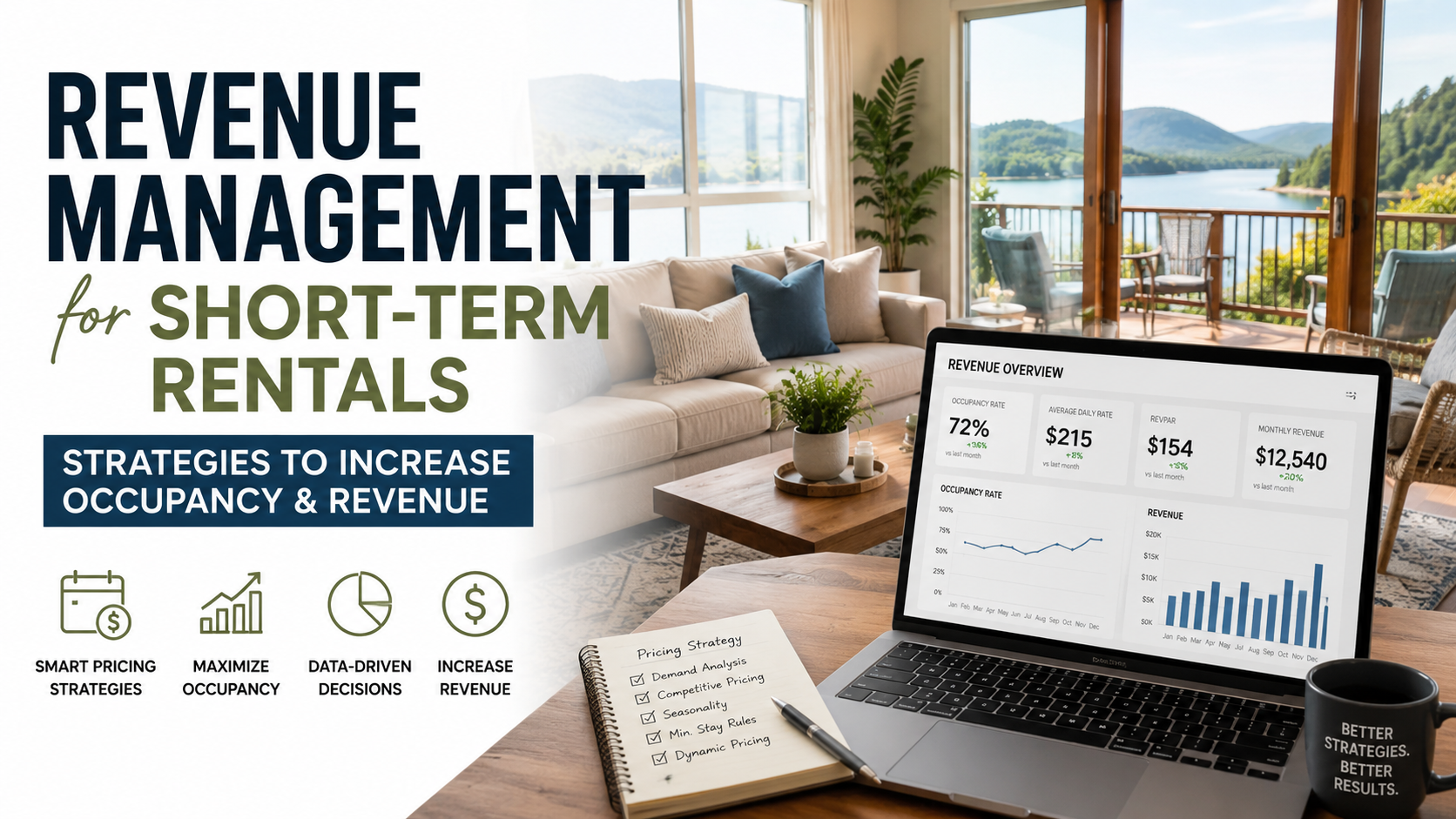
Revenue Management for Short-Term Rentals: Proven Strategies to Maximize Revenue
The short-term rental industry has become increasingly competitive, making strategic pricing more important than ever.
While an attractive property and excellent guest experience help secure positive reviews, long-term success depends on effective property management and, specifically, revenue management for short-term rentals. Instead of relying on fixed nightly rates, successful hosts use data, automation, and market insights to maximize revenue while maintaining healthy occupancy throughout the year.
Whether you manage a single vacation rental or an expanding portfolio of properties, implementing a revenue management strategy allows you to respond to changing traveler demand, seasonal trends, local events, and competitor pricing. By using the right management tools and pricing strategies, property owners can improve booking performance, increase profitability, and make smarter business decisions.
This guide explains the fundamentals of revenue management, key performance metrics, and proven strategies that help short-term rental operators maximize every booking opportunity.
What Is Revenue Management for Short-Term Rentals?
Revenue management is the process of selling the right property to the right guest at the right price and at the right time. Rather than setting one fixed nightly rate throughout the year, revenue management continuously adjusts pricing based on current market conditions.
Several factors influence pricing decisions, including:
- Market demand
- Seasonal travel patterns
- Booking pace
- Local events
- Competitor pricing
- Historical booking data
- Occupancy trends
- Guest booking behavior
The primary goal is to maximize total revenue—not simply increase occupancy. A fully booked calendar at low prices may generate less income than slightly lower occupancy with optimized pricing.
For short-term rental owners, revenue management combines market intelligence, pricing strategies, and automation to create a sustainable, profitable business.
Why Revenue Management Matters
Many hosts assume charging the highest possible nightly rate will increase profits. In reality, pricing too high often reduces bookings, while pricing too low leaves significant revenue on the table.
An effective revenue management strategy helps balance occupancy with profitability by adjusting prices according to market demand.
Benefits include:
- Increased annual revenue
- Higher occupancy during slower periods
- Better booking conversion
- Improved cash flow
- Stronger competitive positioning
- More consistent pricing decisions
- Greater long-term profitability
Whether you manage one listing or dozens of rentals, revenue management helps every property perform more efficiently.
How Revenue Management Supports Long-Term Investment Performance
Revenue management is about more than adjusting nightly rates — it is a strategy for improving the overall financial performance of your vacation rental investment. Every pricing decision influences occupancy, revenue, profitability, cash flow, and long-term owner returns. Rather than reacting to bookings as they happen, successful owners use data to make informed decisions that support sustainable growth and maximize the value of their investment.
Strong revenue management helps owners achieve goals beyond filling a calendar. By aligning pricing with market demand, seasonal travel patterns, and guest booking behavior, you can improve return on investment (ROI), increase net operating income (NOI), generate more consistent cash flow, and strengthen long-term asset performance. These outcomes help create a more resilient vacation rental business while supporting future growth.
Effective revenue management relies on several interconnected strategies rather than a single pricing tactic. Together, these areas provide the insights needed to optimize pricing, respond to changing market conditions, and improve long-term financial performance.
- Market Intelligence & Demand Forecasting – Understand seasonal travel patterns, local events, booking pace, lead time, and market demand before adjusting pricing.
- Pricing Optimization – Build a strong base rate, implement dynamic pricing, adjust for weekends and holidays, and optimize minimum stay requirements.
- Performance Measurement – Track occupancy, Average Daily Rate (ADR), Revenue Per Available Rental (RevPAR), booking trends, and forecasting data to evaluate results.
- Technology & Automation – Use revenue management software, property management systems (PMS), Guesty, PriceLabs, and automation tools to make faster, data-driven pricing decisions.
- Distribution & Revenue Growth – Expand across multiple booking channels, increase direct bookings, optimize gap nights, and reduce vacancy while maintaining profitability.
- Portfolio Optimization – Apply consistent revenue management practices across multiple vacation rentals to improve overall portfolio performance, owner returns, and long-term investment growth.
The greatest results come when these strategies work together. Market demand informs pricing decisions, performance metrics validate those decisions, and automation helps apply them consistently across every booking channel.
The following revenue management strategies explain how each component contributes to stronger occupancy, healthier ADR and RevPAR, greater profitability, and long-term investment success.
Revenue Management Strategies for Short-Term Rentals
1. Understand Market Demand
Market demand is the foundation of every successful revenue management strategy. Before adjusting nightly rates, successful vacation rental owners first seek to understand what influences traveler demand and how those changes affect booking behavior. Pricing decisions are most effective when they respond to real market conditions rather than assumptions.
Demand changes throughout the year as traveler behavior shifts. Seasonal tourism, school calendars, holidays, weather patterns, and regional travel trends all influence when people travel and how much they are willing to pay for accommodations. Understanding these patterns allows owners to anticipate demand instead of reacting after booking activity changes.
Local factors can create equally significant changes in demand. Concerts, sporting events, destination weddings, festivals, conferences, community celebrations, and nearby attractions often increase travel to a market for a short period of time. Revenue managers monitor these events closely because they frequently create opportunities to increase rates while maintaining strong occupancy.
Different types of travelers also book differently. Families often plan vacations months in advance, while couples, business travelers, remote workers, luxury travelers, and last-minute guests each have their own booking windows, travel habits, and price expectations. Understanding these differences helps owners align pricing with guest demand instead of treating every reservation the same.
Successful revenue management evaluates multiple demand signals together rather than relying on a single metric. Key factors include:
- Seasonal Travel Patterns – Peak seasons, shoulder seasons, and slower travel periods.
- Local Events & Attractions – Festivals, concerts, conferences, sporting events, weddings, and tourism activities.
- Booking Pace & Lead Time – How quickly reservations are arriving and how far in advance guests are booking.
- Traveler Segments – Families, couples, business travelers, luxury guests, remote workers, and repeat visitors.
- Competitive Market Conditions – Comparable vacation rentals, hotel occupancy, competitor pricing, and available inventory.
- Destination Trends – Regional tourism, weather conditions, economic activity, and changing travel preferences.
When these signals are viewed together, they create a clearer picture of future demand. Revenue managers can adjust pricing before competitors react, improve occupancy without sacrificing ADR, strengthen RevPAR, and make proactive decisions that improve long-term investment performance.
2. Use Dynamic Pricing Instead of Fixed Rates
Dynamic pricing allows vacation rental owners to adjust nightly rates as market conditions change instead of relying on a fixed price throughout the year. Rather than treating every night equally, dynamic pricing responds to traveler demand, booking activity, and changing market conditions to maximize both occupancy and revenue.
Traveler demand is constantly changing, and pricing should change with it. Guests booking months in advance often behave differently than last-minute travelers, while families, couples, business travelers, and luxury guests each have different booking windows, budgets, and expectations. Dynamic pricing helps align nightly rates with how guests actually search, compare, and book vacation rentals.
Successful dynamic pricing considers multiple market signals before recommending a rate. These signals help revenue managers understand both current demand and future booking opportunities.
- Market Demand – Rising or falling traveler demand influences pricing opportunities throughout the year.
- Booking Pace – Reservation activity indicates whether pricing should increase or become more competitive.
- Lead Time – How far in advance guests are booking helps identify opportunities for early booking premiums or last-minute pricing adjustments.
- Competitor Pricing – Comparable vacation rentals, hotel rates, and available inventory provide valuable market context.
- Seasonality & Local Events – Holidays, school breaks, festivals, conferences, sporting events, and destination-specific travel patterns create predictable changes in demand.
- Property Performance – Historical occupancy, ADR, RevPAR, cancellation trends, and booking history help refine future pricing decisions.
Dynamic pricing is most effective when these signals are evaluated together rather than individually. A major event, for example, may justify higher rates, but only if booking pace, competitor availability, and traveler demand support that decision. Evaluating multiple data points helps owners avoid both underpricing high-demand periods and overpricing slower seasons.
Rather than replacing human decision-making, dynamic pricing gives owners and professional revenue managers better information to make smarter pricing decisions. By combining market intelligence with automation, vacation rental owners can respond more quickly to changing demand, improve occupancy, strengthen ADR and RevPAR, increase profitability, and support the long-term performance of their investment.
3. Monitor Occupancy, ADR, and RevPAR
Revenue management is driven by performance metrics rather than guesswork. Three of the most important measurements include:
Occupancy Rate
Occupancy measures how frequently your property receives bookings. While high occupancy is generally positive, it should always be balanced with profitability.
ADR (Average Daily Rate)
ADR measures the average nightly rate earned from booked reservations. Increasing ADR without significantly reducing occupancy improves overall revenue.
RevPAR (Revenue Per Available Rental)
RevPAR combines occupancy and ADR into one performance metric, providing a more complete picture of how effectively your property generates income.
Tracking these metrics regularly helps identify opportunities for pricing optimization and operational improvements. (FHA)
4. Analyze Booking Pace and Lead Time
Successful revenue managers monitor how quickly reservations arrive.
Booking pace measures how fast bookings are coming in compared to previous periods.
If reservations arrive faster than expected:
- Increase pricing.
- Reduce promotional discounts.
- Raise minimum stay requirements.
If bookings slow down:
- Lower rates strategically.
- Improve listing visibility.
- Offer limited-time promotions.
Lead time — the number of days between booking and arrival — is equally important. Understanding whether guests typically book weeks or months in advance helps determine when prices should increase or decrease.
5. Study Your Competitors
Competitor analysis is essential for effective revenue management.
Rather than copying another property's pricing, create a comp set consisting of similar listings that match your:
- Location
- Property size
- Guest capacity
- Amenities
- Quality
- Target audience
Review factors such as:
- Nightly pricing
- Availability
- Minimum stay rules
- Guest ratings
- Cleaning fees
- Cancellation policies
Using competitor analysis alongside market intelligence helps identify pricing opportunities while keeping your listing competitive.
6. Build a Strong Base Price
Every pricing strategy starts with a realistic base price.
Your base price should reflect your property's value before seasonal demand and automated pricing adjustments are applied.
Factors affecting your base rate include:
- Property location
- Bedrooms and bathrooms
- Amenities
- Historical booking performance
- Market demand
- Operating expenses
- Comparable listings
A properly established base price gives revenue management software a reliable starting point for future pricing optimization.
7. Use Revenue Management Systems and Automation
As your business grows, manually updating every listing becomes increasingly difficult.
A Revenue Management System (RMS) automates pricing decisions by analyzing historical data, competitor pricing, occupancy, booking trends, and future demand.
Many revenue managers also use automation to:
- Update nightly prices
- Monitor market changes
- Generate pricing recommendations
- Analyze portfolio performance
- Forecast future demand
- Produce detailed reports
Automation reduces manual work while improving pricing consistency across every property.
Modern management tools enable operators to make faster, more informed decisions without constantly monitoring market conditions themselves.
8. Integrate Your PMS with Revenue Management
A Property Management System (PMS) helps streamline day-to-day operations while supporting a more effective revenue management strategy. When integrated with a revenue management system, your PMS keeps pricing, calendars, and reservations synchronized across every booking channel.
A modern PMS can help you:
- Sync calendars automatically
- Prevent double bookings
- Manage guest communication
- Coordinate housekeeping
- Track occupancy and revenue
- Generate performance reports
By combining property management with automated pricing, operators spend less time updating listings and more time improving the guest experience.
9. Use Guesty and PriceLabs to Improve Pricing
Many professional property managers rely on Guesty and PriceLabs to automate pricing decisions and manage multiple short-term rental properties.
Guesty centralizes operations by helping managers oversee bookings, guest communication, listings, calendars, and channel management from a single platform.
PriceLabs complements Guesty by using market data, competitor pricing, booking pace, and seasonal demand to recommend optimized nightly rates.
Together, these tools help operators:
- Automate pricing updates
- Improve occupancy
- Increase booking revenue
- Monitor market trends
- Save time with automation
- Manage an entire portfolio more efficiently
Using dedicated revenue management tools helps eliminate guesswork while improving long-term profitability.
10. Diversify Your Distribution Channels
Relying on a single booking platform can limit your property's exposure.
Instead, distribute your listing across multiple channels to reach a wider audience and reduce vacancy risk.
Popular booking channels include:
- Home Team Luxury Rentals
- Airbnb
- Vrbo
- Booking.com
- Direct booking websites
- Google Vacation Rentals
A broader distribution strategy increases visibility while creating additional booking opportunities throughout the year.
Remember to keep calendars synchronized across every channel to avoid double bookings and maintain accurate availability.
11. Increase Direct Bookings
While online travel agencies provide valuable exposure, encouraging direct bookings can improve profitability by reducing commission fees.
Ways to generate more direct reservations include:
- Creating a professional booking website
- Building an email list of returning guests
- Offering exclusive repeat guest discounts
- Encouraging referrals
- Providing personalized guest experiences
A balanced strategy that combines OTA exposure with direct bookings helps create a more sustainable revenue model.
12. Optimize Minimum Stay and Length of Stay
Pricing isn't the only factor affecting revenue.
Your minimum stay and length-of-stay requirements also influence occupancy and profitability.
Consider adjusting stay requirements based on demand.
For example:
- Two-night minimums work well during weekends.
- Longer minimum stays reduce turnover during peak season.
- Weekly discounts attract vacation travelers.
- Monthly discounts appeal to remote workers and extended stays.
Offering flexible stay options allows you to maximize occupancy while reducing operational costs.
13. Fill Gap Nights and Last-Minute Availability
One overlooked revenue management strategy is gap night optimization.
Gap nights are short openings between confirmed reservations that often remain vacant because they don't meet existing minimum stay requirements.
To reduce unused inventory:
- Offer one-night stays when appropriate.
- Adjust minimum stay rules.
- Provide last-minute discounts.
- Use automated pricing rules.
Similarly, last-minute pricing can help fill unsold nights as arrival dates approach.
Rather than leaving nights empty, strategic discounts can generate additional revenue while maintaining healthy occupancy.
14. Adjust Pricing for Weekends, Holidays, and Local Events
Travel demand changes significantly throughout the year.
Instead of applying the same pricing every day, successful operators create pricing strategies based on seasonal demand and local events.
Examples include:
- Holiday weekends
- Music festivals
- Sporting events
- Conferences
- School vacations
- Community celebrations
Weekend pricing often differs from weekday pricing because leisure travel typically increases demand.
Updating rates before these events helps maximize revenue while remaining competitive.
15. Use Data Analytics and Forecasting
The best pricing decisions are based on data—not assumptions.
Regularly reviewing analytics allows property managers to identify trends and improve future performance.
Useful reports include:
- Occupancy trends
- Booking pace
- Average Daily Rate (ADR)
- RevPAR
- Revenue by month
- Cancellation trends
- Guest booking windows
- Length of stay
Demand forecasting uses historical data, seasonal patterns, and current market activity to predict future performance.
This proactive approach helps managers create smarter pricing strategies before demand changes.
16. Scale Revenue Management Across Multiple Properties
Managing multiple properties requires a structured approach to pricing.
As your portfolio grows, standardizing revenue management practices helps maintain consistency while allowing each property to respond to its local market.
Successful operators regularly:
- Review pricing performance
- Compare properties within the portfolio
- Monitor occupancy by location
- Evaluate booking trends
- Update pricing rules
- Refine automation settings
Consistent analysis ensures every property contributes to overall business growth.
17. Common Revenue Management Mistakes to Avoid
Even experienced hosts can lose revenue by making avoidable pricing mistakes.
Common mistakes include:
- Using fixed pricing year-round
- Ignoring seasonal demand
- Failing to monitor competitors
- Relying only on occupancy
- Setting unrealistic base prices
- Overlooking booking pace
- Not reviewing market intelligence
- Ignoring cancellation trends
- Forgetting to optimize listings
- Avoiding automation
Regularly reviewing your pricing strategy helps prevent these issues while improving long-term performance.
Final Thoughts
Successful revenue management for short-term rentals requires more than simply adjusting prices. It combines market intelligence, demand forecasting, competitor analysis, booking trends, and data analytics to create pricing strategies that maximize revenue while maintaining healthy occupancy. By tracking key performance metrics such as ADR, RevPAR, booking pace, and lead time, property owners can make informed decisions that improve long-term profitability.
Whether you own one vacation rental or manage a growing portfolio, partnering with an experienced team like Home Team Luxury Rentals can simplify revenue management while helping you optimize pricing, increase direct bookings, and improve long-term returns. By integrating automation, a reliable PMS, and revenue management tools such as Guesty and PriceLabs, you can optimize every listing, increase direct bookings, respond quickly to market changes, and position your business for sustainable growth.
Frequently Asked Questions
What is revenue management for short-term rentals?
Revenue management is the practice of adjusting pricing based on demand, occupancy, competitor activity, and booking trends to maximize revenue while maintaining healthy occupancy.
Why is dynamic pricing important?
Dynamic pricing automatically adjusts nightly rates according to changing market conditions, helping increase bookings during slower periods and maximize revenue during periods of high demand.
What is ADR?
Average Daily Rate (ADR) measures the average revenue earned for each booked night. Increasing ADR while maintaining occupancy improves overall profitability.
What is RevPAR?
Revenue Per Available Rental (RevPAR) combines occupancy and ADR to measure how effectively a property generates revenue.
Which revenue management tools are popular?
Many operators use Guesty, PriceLabs, Wheelhouse, and Beyond Pricing alongside a Property Management System to automate pricing and improve operational efficiency.
Share to social media
More posts