
PMI Vacation Rental Management Review

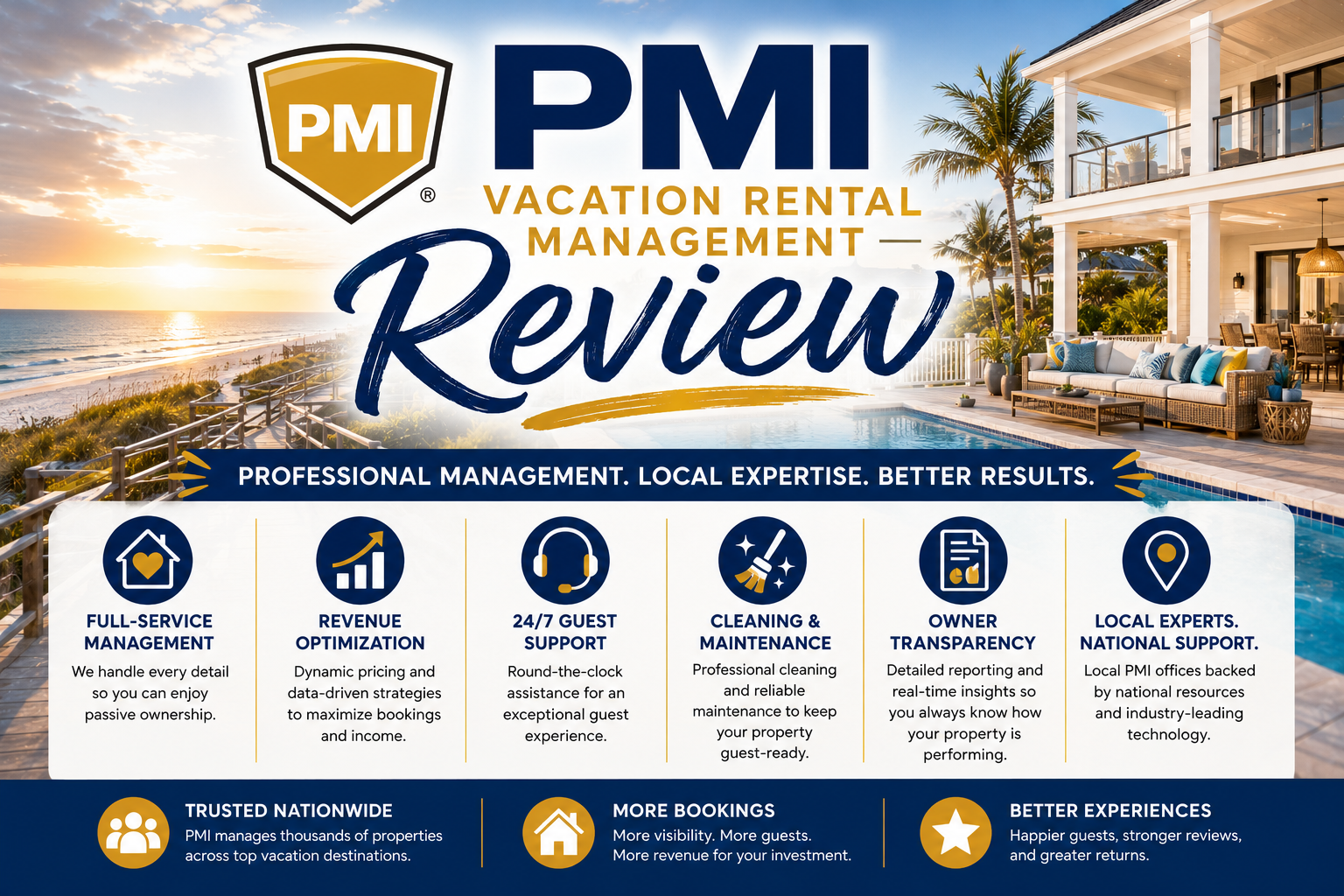
PMI Vacation Rental Management Review
Property Management Inc. offers homeowners a locally operated management model backed by the systems, technology, training, and brand resources of a large national franchise network. Its short-term division handles many of the responsibilities involved in running a professionally operated home, including property preparation, professional photography, listing distribution, housekeeping, maintenance, guest support, and performance planning.
PMI was founded in 2008 and has expanded into a broad property-management franchise serving several real estate sectors. Corporate materials published in 2025 reported more than 450 locations nationwide, giving the organization significantly more geographic reach than many companies focused exclusively on vacation homes.
The short-term business is built around locally owned offices rather than one centralized operating team. Each franchise can provide hands-on care in its own territory while drawing on broader technology and operating resources. That structure is also connected to Global Stays, PMI's guest-facing booking platform, where homes are professionally managed by local franchise partners.
For homeowners, some of the most notable features include:
- Locally based management
- Initial property analysis and planning
- Professional staging guidance
- Photography and 3D virtual tours
- Multi-channel listing exposure
- Housekeeping and maintenance
- 24/7 guest assistance
- Concierge capabilities
- Smart-home technology
- Direct-booking opportunities through Global Stays
- Centralized hospitality and accounting technology
The primary consideration is that PMI operates through independently owned franchises. The national network supplies systems and standards, but pricing, staffing, communication, and execution can depend heavily on the individual office responsible for the home.
Understanding PMI and Its Franchise Model
PMI uses a franchise structure in which independently owned businesses operate under a common brand with access to centralized technology, training, marketing support, software, and operational resources. The broader network spans multiple forms of property management rather than concentrating exclusively on short-term hospitality.
For a homeowner, the practical benefit is access to a nearby property manager who can respond to physical needs while using systems that would otherwise be costly for a smaller independent operator to build.
That combination can be particularly useful because successful short-term operations require both digital and physical execution. Pricing, reservations, reporting, and listing distribution can be supported centrally, while cleaning, inspections, maintenance, and urgent issues require someone capable of coordinating work near the home.
PMI's short-term process is organized around four stages:
- Adapt: Assess the home and develop an operating plan.
- Stage: Prepare the space, technology, house rules, linens, and hospitality details.
- Market: Create professional photography, a 3D tour, and online listings.
- Turn: Handle cleaning, maintenance, and guest-ready preparation between stays.
During the Adapt stage, PMI says it conducts an initial Property Survey and develops a Rentability Report and Property Rental Plan. The objective is to evaluate how the home should operate and identify opportunities to improve profitability before simply placing it online.
This is an important feature of the business model because PMI does not present the home as fixed inventory that only needs reservations. Its published process includes preparing and staging the physical space before moving into marketing and operations.
The Stage portion can address:
- Decorating
- House rules
- Technology
- Linens
- Hospitality details
- Concierge-related features
- Overall guest readiness
That approach makes PMI more comprehensive than a remote listing-management service. The homeowner receives both technology-driven support and physical operating assistance, although the depth of those capabilities can vary by franchise.
Property Management Services and Day-to-Day Operations
PMI's property management offering covers much of the physical work required to keep a short-term home ready for travelers. Local staff can include trained housekeepers and maintenance personnel, with guests receiving 24/7 assistance from the office responsible for their stay.
Core services can include:
- Cleaning between reservations
- Turnover preparation
- Maintenance coordination
- Property inspections
- Guest communication
- Concierge assistance
- Local problem resolution
- Smart-lock and device workflows
- Restocking support
- Reservation management
The local structure can be valuable for absentee homeowners because vacation properties generate frequent operational needs. A traditional long-term home might require attention only occasionally, while a property hosting new travelers several times each month needs repeated cleaning, inspection, supply management, and readiness checks.
Technology increasingly supports those functions. PMI's partnership with BeHome247 gives franchise operators access to automated housekeeping and maintenance workflows, a guest portal, messaging tools, smart-device controls, locks, sensors, and alarms.
Supply management has also become more automated. Through a partnership with sojo, participating franchisees can connect reservation calendars with deliveries of toiletries, paper products, cleaning supplies, snacks, and other consumables needed during turnovers.
For homeowners, the operational questions worth discussing with the individual office include:
- Who performs each inspection?
- Are housekeepers employees or contractors?
- What work is completed by in-house maintenance personnel?
- How are repair approvals handled?
- Is there an owner spending threshold?
- How quickly are urgent issues addressed?
- How are damages documented?
- How are supplies billed?
- Which smart devices are required?
- What happens when a guest reports an issue after normal business hours?
Those details can have as much impact on owner satisfaction as the national brand itself. A sophisticated technology platform is useful, but the quality of the home still depends on consistent physical execution.
Marketing, Global Stays, and the Guest Experience
PMI combines online distribution with active marketing rather than relying exclusively on one booking platform. Its corporate short-term page describes professional photography, 3D virtual tours, search marketing, display advertising, social media, email campaigns, and distribution through major travel channels.
A professionally prepared home can be promoted through channels such as:
- Airbnb
- Vrbo
- Booking.com
- Global Stays
- Search-engine campaigns
- Social media
- Email marketing
- Other supported travel marketplaces
Global Stays plays a distinctive role in this system. The platform allows travelers to search and book homes from participating PMI franchise partners, while the individual office remains responsible for payments, reservation confirmation, communication, maintenance requests, and questions during the stay.
This creates an additional booking ecosystem beyond third-party platforms. In 2026, PMI also announced a partnership with WanderOS aimed at improving direct-booking websites, marketing performance, repeat bookings, and guest engagement for participating short-term operators.
The guest-facing brand also promotes standardized hospitality elements through programs such as:
- PMI Purify: Cleanliness standards
- PMI Bed: Bedding and comfort
- PMI Scent: Arrival atmosphere
- PMI Coffee: In-home coffee amenities
Global Stays describes these elements as part of a premium guest experience designed to create greater consistency across independently operated homes.
That standardization can be useful in a franchise environment. Travelers may encounter different houses and different local operators, but recognizable hospitality practices can create a more consistent expectation around cleanliness, comfort, and arrival experience.
Distribution still should not be confused with competitiveness. Putting a home on several channels increases exposure, but travelers ultimately compare factors such as:
- Photography
- Nightly price
- Amenities
- Interior presentation
- Sleeping capacity
- Location
- Reviews
- Cleanliness
- Outdoor spaces
- Overall perceived value
A well-positioned vacation home may primarily need stronger exposure and professional operations. A dated or poorly differentiated home may require more significant physical improvements before increased traffic produces the desired booking performance.
Technology, Pricing, and Owner Economics
Technology is one of the strongest components of PMI's operating system. The organization has continued expanding its short-term technology stack through partnerships intended to improve reservations, communication, housekeeping, maintenance, accounting, smart-home control, and direct bookings.
In 2025, PMI announced an exclusive partnership with Guesty to provide hospitality-management technology to its short-term operators. Guesty supports reservation and operational workflows, while BeHome247 adds smart-property and maintenance capabilities.
The technology stack expanded again in August 2026 when PMI partnered with Topkey, an accounting platform designed for short-term operators. The integration can connect with systems including Guesty, QuickBooks, Amazon Business, and booking platforms to categorize expenses, match receipts, reconcile payouts, and provide greater visibility into financial performance.
That infrastructure can be particularly useful for an owner who wants professional reporting without personally reconciling every reservation and operating expense.
Pricing should still be evaluated at the franchise level. PMI does not publish one universal consumer management fee on its primary short-term homeowner page. Its franchise-development materials instead describe short-term management as generating approximately 25% to 45% of the nightly rate for franchise operators. That figure should be viewed as franchise-business guidance rather than a guaranteed nationwide homeowner price.
The individual office should provide a proposal explaining:
- Commission structure
- What revenue the percentage applies to
- Cleaning charges
- Maintenance costs
- Repair markups
- Supply expenses
- Photography or setup costs
- Technology charges
- Payment-processing expenses
- Contract terms
- Owner-use rules
- Cancellation provisions
A homeowner should also ask how the office sets and adjusts the nightly rate. The best pricing strategy considers current demand, seasonality, comparable homes, booking pace, events, length of stay, and available inventory rather than relying on a static seasonal calendar.
The economics should ultimately be judged on net performance. A lower percentage does not automatically create the best return if the home receives weaker pricing, fewer bookings, or requires substantial owner involvement. Conversely, a higher rate of compensation can be difficult to justify unless the operator delivers enough additional revenue or convenience to offset the cost.
Reviews, Strengths, and Potential Tradeoffs
Evaluating national reviews for PMI requires more caution than it would for a centrally operated company. Individual franchises are independently owned and operated, so the homeowner relationship, staffing, responsiveness, and operating quality may vary substantially from one market to another.
For that reason, a single national average rating is not especially useful when deciding whether a particular office should manage a home. Due diligence should focus on the actual franchise serving the destination.
Before signing an agreement, homeowners can research:
- Google feedback for the local office
- Guest comments on comparable listings
- Recent owner testimonials
- Cleaning complaints
- Maintenance responsiveness
- Staff communication
- Length of time the franchise has operated
- Experience with similar homes
- Response to negative feedback
- References from current clients
The strongest features of the model include:
- A nearby operator backed by national infrastructure
- Professional property preparation
- Local housekeeping and maintenance
- 24/7 guest assistance
- Technology-supported operating workflows
- Professional photography and 3D tours
- Broad online promotion
- Direct-booking infrastructure
- Hospitality standards
- Access to accounting and smart-home technology
PMI also distinguishes itself by providing a process for adapting and staging homes rather than limiting its role to reservations. This makes its vacation property management approach more comprehensive than a platform that only handles online operations.
There are several potential tradeoffs:
- Execution depends heavily on the individual franchise.
- Pricing is not standardized nationally.
- Office experience with high-end homes may vary.
- Design capabilities can differ by operator.
- A broader property-management network may not have the same specialization in luxury short-term assets in every destination.
- Homeowners need to verify which services are actually included locally.
The franchise structure can therefore be both a strength and a variable. An experienced operator with strong housekeeping, hospitality, and pricing systems may provide excellent hands-off service, while the national brand alone cannot guarantee identical execution in every market.
PMI vs. Home Team Luxury Rentals
PMI and Home Team Luxury Rentals both provide comprehensive short-term operations, but they are built around different organizational models and portfolio strategies.
PMI operates through a large national franchise system covering multiple types of real estate management. Its short-term program combines locally operated businesses with corporate training, technology, marketing resources, hospitality standards, and platforms such as Global Stays.
Home Team Luxury Rentals is more specifically focused on high-performing premium and luxury short-term homes. Its published property management program combines dynamic pricing, listing optimization, multi-platform distribution, guest communication, cleaning coordination, maintenance oversight, reporting, and ongoing property-performance analysis.
| Category | PMI / Global Stays | Home Team Luxury Rentals |
|---|---|---|
| Primary model | National franchise network with independently operated local offices | Full-service operator specializing in premium and luxury short-term homes |
| Portfolio focus | Broad property-management platform spanning multiple asset classes | Greater specialization in high-performing short-term investment properties |
| Local operations | Local franchise staff handle housekeeping, maintenance, and guest needs | Local vendors and operating partners work within centralized performance systems |
| Property preparation | Adapt, Stage, Market, Turn process with surveys, staging, photography, and technology | Property analysis, positioning, design, amenities, listing optimization, and operating setup |
| Revenue strategy | Market-specific pricing executed by franchise operators using shared tools and technology | Active pricing based on demand, booking pace, competition, and positioning |
| Distribution | Major booking channels plus Global Stays and direct-booking technology | Major OTAs plus listing optimization and multi-platform distribution |
| Guest support | 24/7 assistance through the individual franchise | Round-the-clock communication and hospitality operations |
| Technology | Guesty, BeHome247, Topkey, WanderOS, smart-home tools, and operational integrations | Pricing, reporting, communication, and performance systems supported by local execution |
| Property staging | Standardized process includes decorating, technology, linens, and hospitality setup | Interior design and furnishing strategy focused heavily on marketability and performance |
| Amenity strategy | Hospitality and concierge features incorporated into property preparation | Amenities evaluated for booking demand, ADR, occupancy, and differentiation |
| Management pricing | Varies by independently operated franchise | Typically 15%–22% depending on home, market, and operating requirements |
| Best fit | Owners who value a locally operated office supported by a large national system | Owners seeking specialized premium-property and investment performance optimization |
There is substantial overlap between the two approaches. PMI already evaluates the physical home, helps stage it for travelers, provides professional media, offers concierge capabilities, and uses technology to improve operations. It would therefore be inaccurate to characterize the company as simply a listing or distribution provider.
The more meaningful distinction is specialization.
PMI's broader network supports residential, commercial, association, and short-term businesses, allowing franchise owners to work across several areas of property management. Home Team Luxury Rentals concentrates more directly on high-performing short-term investment homes and treats design, amenities, listing conversion, pricing, and physical improvements as interconnected parts of asset performance.
Home Team's design program, for example, emphasizes:
- Photo-ready interiors
- Layout and styling
- Hot tubs
- Fire pits
- Game rooms
- Coffee bars
- Market-specific differentiation
The company explicitly connects those improvements with traveler interest and stronger booking performance.
Home Team currently publishes a typical management range of 15% to 22%, depending on the home's location, expected performance, operating complexity, and required scope. It also offers access to acquisition, design, construction, and portfolio-scaling resources through its broader investment ecosystem.
When PMI may be the stronger fit
PMI may appeal most to homeowners who prioritize:
- A locally owned office
- A large national franchise infrastructure
- Professional housekeeping and maintenance
- A defined staging process
- Global Stays distribution
- Smart-property technology
- Concierge capabilities
- Broader real-estate management expertise
A homeowner who already has a competitive house and primarily wants reliable operations, professional presentation, and local accountability may find this model particularly attractive.
When Home Team Luxury Rentals may be the stronger fit
Home Team may deserve closer consideration when priorities include:
- Premium-property positioning
- High-impact amenity strategy
- In-depth competitive analysis
- Interior design tied to bookings
- Renovation or construction guidance
- Portfolio acquisition support
- Active listing conversion optimization
- Long-term investment performance
A large home with weak gathering spaces, dated interiors, limited entertainment, or underused outdoor areas may have more upside from a strategy that goes beyond operational readiness. In that situation, improvements to design, sleeping configurations, amenities, and positioning can become as important as cleaning and channel distribution.
Neither operating model is automatically superior. The appropriate choice depends on whether the homeowner primarily needs a capable local operator supported by a nationwide franchise or a more specialized manager focused on maximizing the performance of a premium short-term asset.
How does PMI compare with Home Team Luxury Rentals?
Both offer extensive operating and performance services. PMI combines independently operated franchises with national technology, staging systems, hospitality tools, and Global Stays, while Home Team Luxury Rentals specializes more heavily in premium short-term investments and connects design, amenities, competitive positioning, pricing, and physical improvements to long-term asset performance.
PMI offers a comprehensive option for homeowners who want local management backed by the resources of a national organization. Its Adapt, Stage, Market, and Turn process addresses much more than online reservations, while partnerships with Guesty, BeHome247, WanderOS, Topkey, and other technology providers give franchise operators a growing set of tools for hospitality and operational management.
The independently operated franchise structure remains the most important due-diligence consideration. A homeowner should investigate the specific office's staffing, pricing, experience, communication, and record with comparable homes before choosing a manager.
For a well-positioned vacation property that primarily needs dependable local care, professional presentation, broader exposure, and modern operating systems, PMI can be a compelling option. For a premium asset whose greatest opportunity lies in deeper design work, amenity investment, competitive repositioning, or portfolio-level strategy, comparing the local PMI offering with a specialized operator such as Home Team Luxury Rentals can help identify which approach better matches the owner's goals.
Frequently Asked Questions
Does PMI provide full vacation rental management?
Yes. PMI's published short-term services include property analysis, staging, photography, digital marketing, guest support, housekeeping, maintenance, and concierge assistance. The exact package can vary because individual offices are independently operated.
How does Global Stays work with PMI?
Global Stays is the booking platform for homes managed by participating PMI offices. Travelers use the platform to find and reserve properties, while the local franchise handles payments, booking confirmation, communication, maintenance requests, and assistance during the stay.
How much does PMI charge homeowners?
PMI does not publish one nationwide consumer price for every short-term franchise. The company's franchise materials describe short-term management revenue in a range of roughly 25% to 45% of nightly revenue, but homeowners should request an individual quote because each independently operated office can establish its own pricing and service structure.
What Should You Ask a Property Manager About an Airbnb Management Fee?
Before signing an agreement, homeowners should ask exactly what the quoted fee includes and which expenses are billed separately. Important items to clarify include housekeeping, maintenance, listing setup, guest communication, payment processing, supplies, repairs, and contract termination terms. Comparing the complete scope of service makes it easier to determine whether the pricing provides good value for the vacation home.
Share to social media
More posts