
Luxury Group Travel Phoenix: What Guests Want From a Private Home


Luxury Group Travel Phoenix: Private Home Features Groups Expect
Traveling with a large group changes almost every part of the accommodation decision. Families, groups of friends, corporate travelers, golf groups, wedding parties, and multigenerational families need more than enough beds. They need a property that gives everyone space to gather, space to separate, and enough built-in experiences that staying home can be just as enjoyable as exploring the destination.
That is one reason private homes have become such a strong fit for upscale group trips. Instead of dividing everyone among several hotel rooms, guests can share kitchens, pools, patios, entertainment areas, and common spaces while maintaining privacy in individual bedrooms.
For travelers comparing Phoenix vacation rentals, the most appealing homes tend to combine thoughtful design, strong amenities, easy logistics, and a clear understanding of how groups actually spend their time.
Why Phoenix Groups Prefer a Private Home
Hotels can work well for short trips, but they naturally separate travelers. One couple may be on the fourth floor while another family is several hallways away. Coordinating meals, pool time, conversations, and evening plans can become part of the daily routine.
A private home changes that dynamic.
Guests can wake up under one roof, prepare breakfast together, relax around a private pool, and regroup throughout the day without arranging a meeting place. For families traveling with children or grandparents, that convenience can significantly shape the quality of the stay.
The appeal is particularly strong for a Phoenix vacation centered on spending time together. Instead of treating accommodation as somewhere the group leaves every morning, the house itself becomes part of the itinerary.
This also explains why large properties can compete differently from traditional hotels. Travelers are not necessarily comparing one bedroom against another. They are comparing an entire private environment against a collection of separate rooms and shared public spaces.
Stay-Type Psychology Shapes the Booking Decision
Not every traveler evaluates a rental the same way. The reasons behind a trip determine which features feel essential, which feel optional, and which can influence someone to book one property instead of another.
This is the principle behind stay-type psychology for Airbnb guests.
A couple taking a short weekend trip may focus on atmosphere, location, and privacy. A family reunion might care much more about bedroom configuration, laundry, pool safety, dining capacity, and flexible common areas. Corporate groups attending Phoenix meetings may place greater emphasis on Wi-Fi, individual beds, workspace, parking, and straightforward transportation.
Golf groups have another set of priorities. Wedding parties, wellness groups, and friends taking annual vacations have their own.
Owners who understand those differences can craft a much stronger property experience because the home is designed around a specific use case instead of trying to appeal equally to everyone.
For guests, that alignment is often what makes a property feel unusually well suited to the trip.
Luxury Amenities Matter More Than Bedroom Count
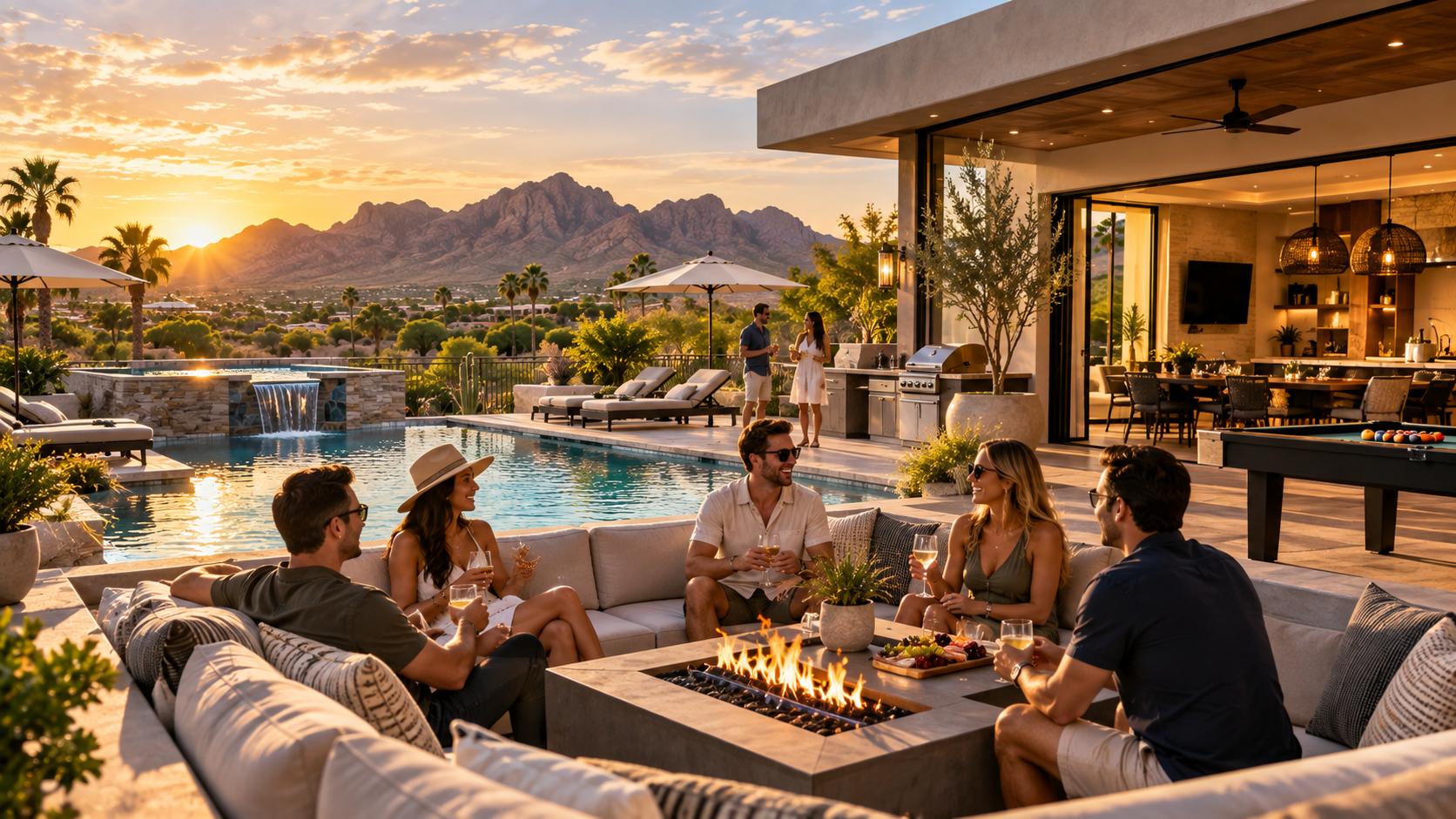
A property advertised for twelve guests is not automatically comfortable for twelve guests.
Bedroom count is only one part of group capacity. Travelers also notice bathroom access, seating, kitchen size, parking, outdoor space, dining capacity, storage, and whether the home's social spaces can comfortably hold everyone at once.
Imagine twelve people arriving at a large house with six bedrooms but only six dining chairs. The listing may technically accommodate the group, but the experience does not.
Strong group properties think beyond occupancy.
Features that often matter include:
- Multiple bathrooms and private sleeping areas
- A dining table that fits most or all of the group
- A well-equipped kitchen designed for full meals
- Several indoor and outdoor conversation areas
- Poolside seating for more than a few guests
- Parking that matches the property's realistic capacity
- Games or entertainment that different age groups can enjoy
- Laundry and storage for longer stays
The same principle applies to amenities. The strongest amenities create experiences rather than simply filling space.
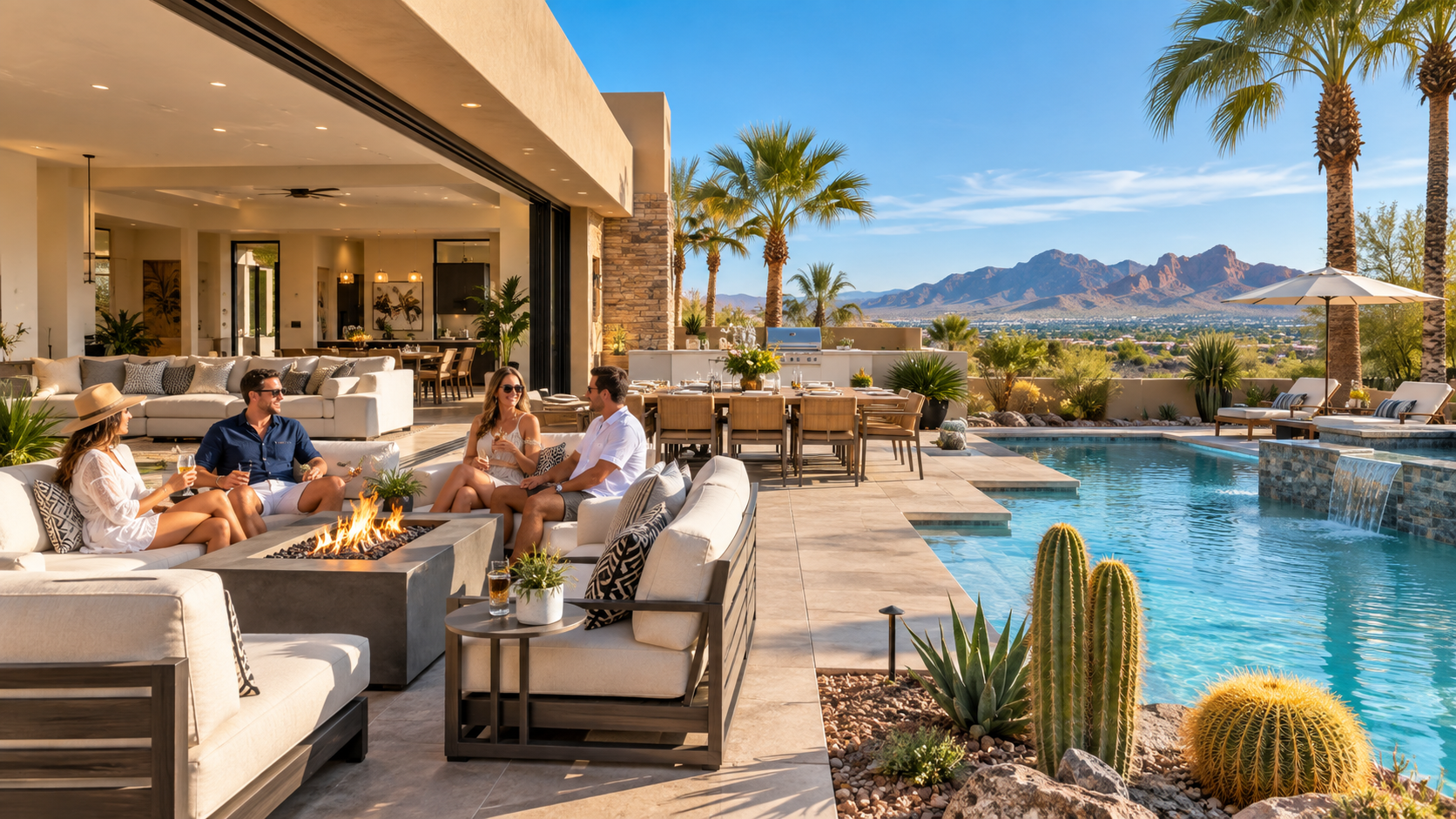
A private pool creates an afternoon activity. A fire pit creates an evening gathering place. A game room gives younger travelers somewhere to spend time while other guests relax outside.
Our guide to vacation rental amenities goes deeper into the features that can distinguish a high-end home from an ordinary large rental.
Outdoor Living in Phoenix Turns the Home Into the Experience
The desert setting makes indoor-outdoor living particularly important.
For much of a group trip, travelers may prefer spending time around a pool, shaded patio, outdoor television, dining table, or fire feature rather than constantly moving between attractions.
That means outdoor space should function as an extension of the house.
A visually impressive backyard with inadequate seating is less useful than one carefully arranged around the way people actually gather. Shade structures can extend the amount of time guests comfortably spend outside. Large tables encourage shared meals. Outdoor kitchens reduce the need to move repeatedly between the patio and indoor kitchen.
Homes with strong outdoor design may also become natural choices for travelers interested in wellness travel in Phoenix, where privacy, relaxation, movement, and slower days at the property can become central parts of the trip.
The surrounding mountains also contribute to the destination experience. Views, desert landscaping, outdoor seating, and quiet morning spaces can make the property feel connected to the Southwest rather than interchangeable with a rental in another city.
Owners interested in this positioning can also explore luxury outdoor living in Phoenix for a closer look at how pools, patios, dining areas, and recreation spaces influence guest appeal.
Private Transportation and Phoenix Location Shape the Stay
Group travel becomes complicated when everyone needs to move independently.
Some parties arrive with multiple rental cars. Others arrange group transportation so everyone can attend activities together. Depending on the itinerary, guests might use private transportation, a limo service, or executive transportation for airport transfers, dinners, events, or special occasions.
A group may even schedule a private tour or other guided tours as part of the trip.
The important point for a private home is access. Guests need to understand parking capacity, approximate travel patterns, neighborhood characteristics, and how easily the property connects with the places they intend to visit.
Across greater Phoenix, groups may build itineraries around golf, sporting events, shopping, hiking, nightlife, wellness experiences, and restaurants rather than spending the entire trip in one neighborhood.
Location therefore does not always mean being closest to downtown.
A quieter residential property with better outdoor space may outperform a more central home for travelers who expect to spend substantial time at the house. Our guide to Phoenix luxury neighborhoods provides additional context on how different areas can serve different travel styles.
Travelers can also use things to do in Phoenix to plan activities around the type of group they are bringing.
High-End Expectations Are About Ease, Privacy, and Service
The psychology behind luxury travel is not simply about expensive furniture or oversized houses.
Guests paying more usually expect fewer points of friction.
They expect clear arrival information, reliable Wi-Fi, comfortable beds, responsive communication, clean outdoor areas, properly functioning amenities, adequate kitchen supplies, intuitive technology, and a property that looks and feels consistent with the listing.
These expectations become even more important with a large group because one small problem can affect many people.
If climate control is difficult to operate, several bedrooms may become uncomfortable. If the kitchen lacks enough cookware, preparing dinner for ten people becomes frustrating. If parking instructions are unclear, multiple arriving vehicles may encounter the same issue.
The strongest homes remove those obstacles before guests notice them.
The broader psychology behind these decisions is explored in our guide to luxury traveler expectations.
Privacy also matters. Private pools, enclosed yards, dedicated gathering areas, and bedrooms separated from the busiest social spaces give groups greater control over their time.
That control is difficult to replicate on cruises, at large resorts, or in properties where guests constantly share facilities with strangers.
Experiential Hospitality Creates Better Group Stays
A private home can provide more than accommodation. It can become part of the story travelers tell about the trip afterward.
That idea sits at the center of experiential hospitality.
Instead of asking only whether the property has enough bedrooms, owners can consider what guests will actually do there.
Will everyone gather outside after dinner? Is there a pool where families can spend an afternoon? Can the group watch a game together? Is there enough counter space for several people to cook? Can guests organize a catered dinner without rearranging the entire house?
Those experiences become especially important during destination-driven trips.
Sports fans visiting during Phoenix spring training may spend part of each day attending baseball games and the rest relaxing together at the house.
Golf groups researching Phoenix golf tourism may value a hot tub, putting area, television setup, and flexible sleeping configuration almost as much as proximity to courses.
Groups traveling around concerts, sporting events, celebrations, and conventions may have yet another set of priorities. The role those trips play in demand is explored further in Phoenix event tourism.
Nearby Scottsdale provides another example of the same behavior. Our guide to Scottsdale group travel shows how private pools, gathering spaces, amenities, and shared accommodations align with larger leisure groups across the Valley.
Experiential hospitality therefore means specializing in the moments guests want to have rather than simply offering a place where they can sleep.
What This Means for Owners and Property Managers
Owners targeting larger groups should begin by defining exactly who the property serves.
A family-focused home should not necessarily be equipped or marketed the same way as a golf house, corporate retreat, celebration property, or wellness-oriented stay.
That positioning influences photography, bedroom configuration, amenities, pricing, listing copy, guest communication, and even maintenance priorities.
The property's capacity should also match its real-world functionality. If a home sleeps fourteen, owners should consider whether fourteen guests can comfortably eat, sit outside, park, shower, prepare food, and move throughout the property.
This is where professional Phoenix property management becomes more than handling cleaning schedules and guest messages.
Strong management considers market positioning, guest psychology, property presentation, revenue strategy, maintenance standards, and the overall hospitality experience.
Owners with properties outside the metro can apply many of the same principles through a broader Arizona property management strategy.
The goal is not to add every possible amenity. It is to create a coherent property designed around the travelers most likely to value it.
When a home's space, amenities, location, service, and marketing reinforce the same type of stay, guests can recognize its value more quickly—and the experience is more likely to match what convinced them to book.
FAQs
What do groups look for in a private vacation home?
Most groups want a balance of shared space and individual privacy. Large kitchens, comfortable dining areas, pools, multiple bathrooms, flexible bedrooms, parking, and indoor-outdoor gathering areas can all influence the booking decision.
Why do groups choose a private home instead of several hotel rooms?
A private home allows travelers to spend more of the trip together. Guests can share meals, relax around the same pool, gather in one living room, and enjoy outdoor areas without coordinating between separate rooms and public hotel spaces.
Which amenities matter most for a large group?
Pools, hot tubs, outdoor dining areas, game rooms, fire pits, well-equipped kitchens, large televisions, comfortable common spaces, laundry facilities, and sufficient parking are especially useful. The best amenity mix depends on the specific type of group.
Do different types of groups want different properties?
Yes. Families, corporate groups, golf travelers, wedding parties, wellness groups, and friends traveling together can have very different priorities. Understanding the reason for the trip helps owners align amenities, sleeping arrangements, and marketing with the right audience.
How can owners attract more high-value group bookings?
Owners can improve positioning by matching the property's realistic capacity with its amenities, layout, photography, pricing, and guest experience. To learn more about positioning and operating a group-oriented home, owners can review local market strategy and professional management options before deciding which improvements best fit the property.
Share to social media
More posts