

Airbnb Management vs Self-Managing: Which Is More Profitable?
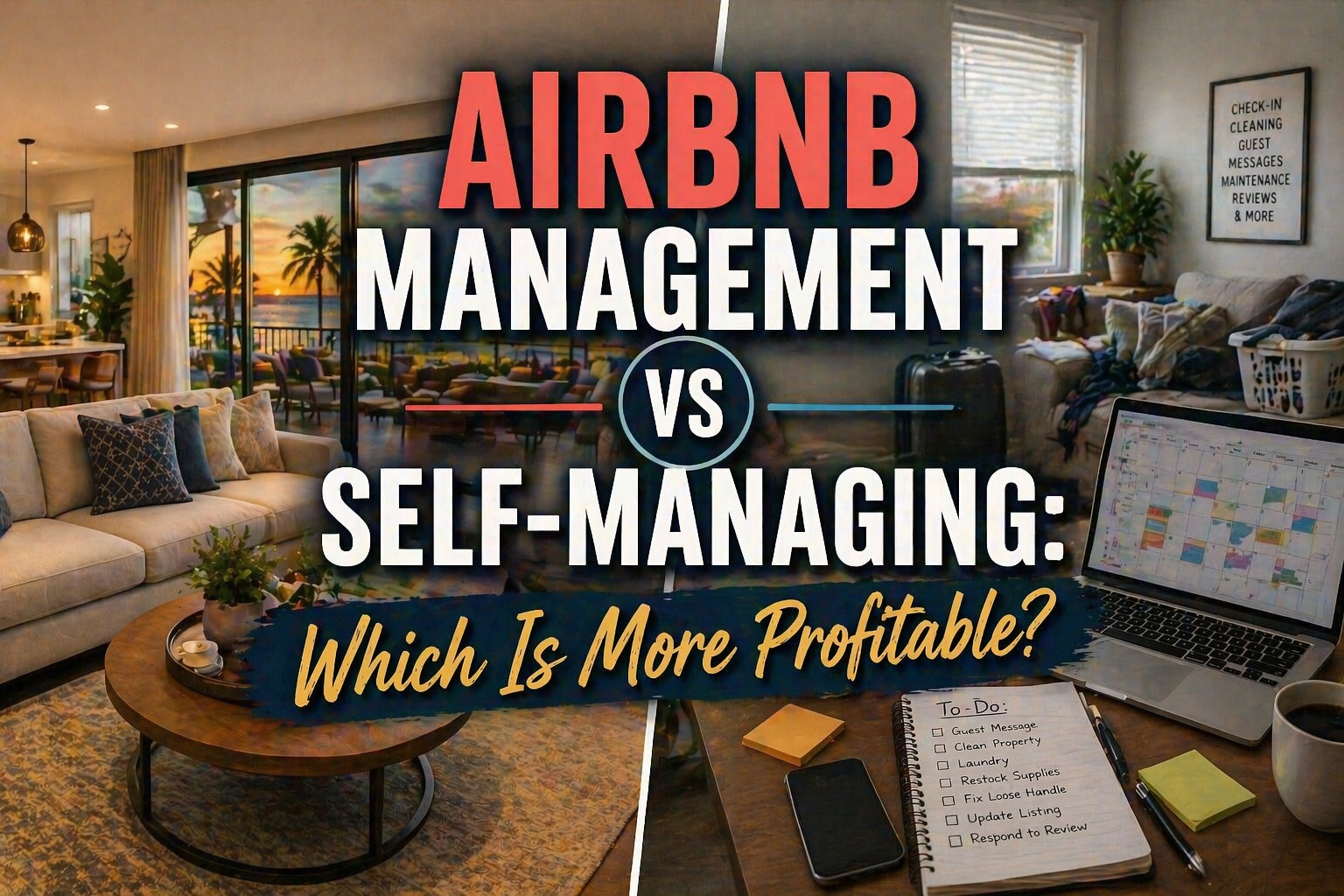
Airbnb management vs self-managing is ultimately a decision about performance, not just cost.
Most comparisons focus on management fees, control, or convenience. But for property owners and investors, the real question is simpler:
Which approach produces more revenue—and better long-term returns?
Because in short-term rentals, profitability is not determined by who does the work.
It’s determined by how well the work is executed across pricing, occupancy, and guest experience.
Why This Comparison Matters More Than Most Owners Realize
At a glance, self-managing appears more profitable because it avoids management fees. But this assumption ignores how revenue is actually generated in the short-term rental market.
Performance is driven by a small set of variables that compound over time:
- Nightly pricing strategy (ADR)
- Occupancy rate across seasons
- Listing conversion rate
- Guest experience and reviews
- Market positioning against competing listings
What’s often overlooked is how sensitive these variables are to execution.
According to the academic study Research on the Impact of Dynamic Pricing on Revenue Based on Airbnb Data, dynamic pricing strategies can increase annual income by approximately 30% compared to static pricing models. This reinforces a core principle: execution—especially pricing—directly impacts revenue outcomes.
Real-world operator data shows that dynamic pricing systems typically increase revenue by 10% to 40% annually, along with measurable improvements in RevPAR and booking performance.
At the individual booking level, pricing strategy becomes even more impactful. Data from PriceLabs shows that peak demand pricing adjustments can increase nightly rates by 50% to 200%, capturing value that static pricing models miss entirely.
In other words, two nearly identical properties can produce very different results depending on how they are managed.
What Is Self-Managing an Airbnb?
Self-managing an Airbnb means the property owner is responsible for every aspect of the operation—from pricing to guest communication to maintenance.
This is not just hosting. It is running a full hospitality business.
Core responsibilities of self-managing include:
- Setting and adjusting nightly pricing
- Managing calendars and booking settings
- Communicating with guests before, during, and after stays
- Coordinating cleaning and maintenance
- Optimizing the listing (photos, amenities, descriptions)
- Monitoring reviews and responding to feedback
Self-managing gives full control over decisions and operations. However, it also requires consistent time, attention, and market awareness.
What matters most is not whether these tasks are completed, but how consistently and effectively they are executed over time.
In practice, many self-managed properties rely on static or infrequently updated pricing. Pricing strategies that actively adjust based on demand, booking pace, and occupancy trends can significantly improve both nightly rates and booking volume, but require consistent monitoring and adjustment.
What Is Airbnb Property Management?
Airbnb property management involves hiring a professional company to handle the day-to-day operation and optimization of a short-term rental.
This typically includes both operational execution and revenue strategy.
Core responsibilities of Airbnb management include:
- Dynamic pricing based on demand, seasonality, and booking pace
- Listing optimization across platforms (Airbnb, Vrbo, Booking.com)
- Guest communication and support
- Cleaning coordination and quality control
- Performance tracking and reporting
- Ongoing adjustments based on market data
Professional managers operate within a fundamentally different framework.
Dynamic pricing systems continuously adjust rates based on supply and demand conditions, allowing operators to increase prices when demand is high and lower them strategically when demand softens.
This allows operators to increase prices when demand is high and lower them strategically when demand softens—maximizing both occupancy and revenue.
More advanced systems go even further. Operators like AvantStay identify dozens of micro-season demand windows throughout the year—short periods where pricing can be adjusted to capture incremental revenue that traditional seasonal pricing models overlook.
The goal is not just to maintain the property, but to continuously optimize performance.
Airbnb Management vs Self-Managing: The Real Difference
At a surface level, both approaches involve the same core activities:
- Pricing the property
- Managing bookings
- Maintaining the guest experience
- Optimizing the listing
But the real difference is not the tasks—it is the consistency, speed, and quality of execution.
- Self-managing relies on the owner’s time, experience, and ability to adapt
- Airbnb management relies on systems, automation, and continuous optimization
This distinction matters because short-term rental performance is highly sensitive to small changes.
For example, pricing strategies that actively balance demand have been shown to increase occupancy while also increasing revenue. Data from PriceLabs indicates that optimized pricing can produce ~11% higher occupancy alongside revenue gains, highlighting how these variables work together—not independently.
Over time, these incremental improvements compound into significantly higher annual returns.
Why Most Comparisons Get This Wrong
Airbnb management vs self-managing is often framed as a simple cost decision:
- Self-managing = no management fees
- Management = 10–30% of revenue
But this overlooks the most important factor:
Revenue is not fixed—it is variable based on performance.
What many owners fail to consider:
- How pricing strategy affects nightly rates
- How listing optimization impacts conversion
- How demand timing influences occupancy
- How their property compares to top-performing listings nearby
From a foundational standpoint, dynamic pricing exists to align supply and demand in real time. As outlined by Harvard Business School, businesses that adjust pricing dynamically can optimize both utilization and profitability simultaneously.
In short-term rentals, this means:
- Lower prices strategically to maintain occupancy during slow periods
- Increase prices aggressively when demand spikes
- Capture revenue across dozens of micro-demand windows throughout the year
A property that executes this well can generate significantly more revenue—even after accounting for management fees.
What This Article Will Help You Understand
This guide breaks down Airbnb management vs self-managing from a performance perspective—not just a cost comparison.
In the sections that follow, we’ll cover:
- The pros and cons of each approach
- How Airbnb revenue is actually generated
- Real-world revenue scenarios and comparisons
- Where self-managing tends to fall short
- When professional management becomes more profitable
The goal is to give you a clear framework for making a decision based on outcomes—not assumptions.
Bottom Line
Airbnb management vs self-managing is not simply about who does the work—it is about how effectively the work is done.
The same property, in the same market, can produce very different results depending on how it is managed.
The difference is not the model—it is the execution behind it.
Frequently Asked Questions
Share to social media
More posts